

Last reviewed: 14 July 2026
A foreign-owned property developer acquiring land in Queensland may face Additional Foreign Acquirer Duty, commonly referred to as AFAD, in addition to ordinary transfer duty.
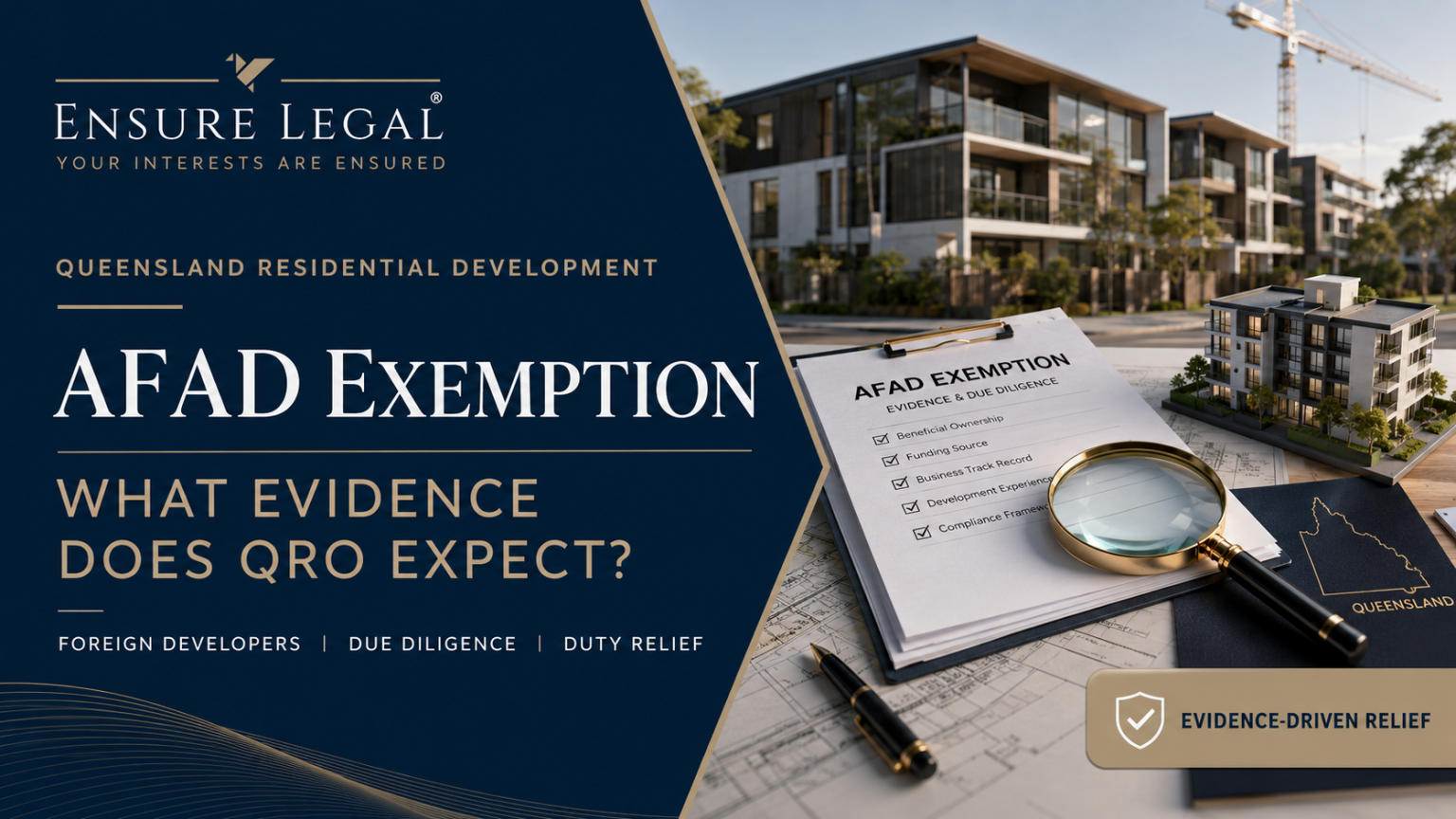
In some development circumstances, the Queensland Government may consider granting ex gratia relief from AFAD. However, relief is discretionary. It is not an automatic consequence of obtaining FIRB approval, purchasing development land or proposing to increase housing supply.
A successful application generally depends on the strength of the development proposal, the applicant’s commercial capacity, the anticipated benefit to Queensland and the quality of the supporting evidence.
AFAD relief is not the same as a statutory exemption
It is important to distinguish between a statutory exemption and ex gratia relief.
A statutory exemption applies where the transaction satisfies requirements contained in the relevant legislation.
Ex gratia relief is different. It involves the government exercising a discretion to provide relief in circumstances where duty would otherwise be payable.
This means that:
- an applicant is not automatically entitled to relief;
- each application is assessed on its own facts;
- the government may request further information;
- conditions may be imposed if relief is granted; and
- relief may be unavailable where the proposed development is uncertain, speculative or insufficiently supported.
Who may consider applying?
Ex gratia relief may be relevant to a foreign-owned entity acquiring Queensland land for a genuine property development project.
Depending on the project and current government policy, relevant applicants may include:
- residential property developers;
- mixed-use project developers;
- build-to-rent developers;
- developers acquiring vacant or underutilised land;
- foreign-owned Australian development companies; and
- joint ventures involving foreign ownership or control.
Merely holding land, undertaking a small renovation or acquiring an investment property is unlikely to establish the same case as a properly funded and documented development project.
What may the Queensland Revenue Office examine?
The Queensland Revenue Office may consider the complete commercial and development context rather than relying on a single document.
Relevant matters may include:
- the nature and scale of the proposed development;
- the number and type of new dwellings or premises to be created;
- the project timetable;
- the applicant’s financial and operational capacity;
- planning and development approvals;
- the applicant’s development history;
- the project’s economic contribution to Queensland;
- employment and local expenditure;
- the certainty that the development will proceed;
- the applicant’s foreign ownership and control structure; and
- whether the applicant is willing and able to comply with any conditions attached to relief.
Evidence of the proposed development
The application should provide a coherent description of what will be developed, when it will be delivered and how the applicant intends to complete the project.
Depending on the stage of the project, useful evidence may include:
- the signed acquisition contract;
- title searches and survey plans;
- development applications;
- planning approvals and conditions;
- architectural plans;
- concept plans and feasibility studies;
- building approvals;
- construction programs;
- quantity surveyor reports;
- development budgets;
- consultant reports;
- infrastructure agreements;
- pre-sale or leasing strategies; and
- anticipated completion dates.
A broad statement that the land may be developed in the future is generally less persuasive than a documented and commercially advanced proposal.
Evidence of financial capacity
An applicant should be prepared to demonstrate that it has a realistic ability to acquire, fund and complete the development.
Relevant supporting material may include:
- audited financial statements;
- bank or financier letters;
- loan facility documents;
- equity commitment documents;
- group financial statements;
- parent-company support arrangements;
- cash-flow forecasts;
- funding models;
- evidence of development finance experience; and
- documents explaining the source of development capital.
Where funding depends on future approvals, pre-sales, capital raising or related-party support, the application should explain those dependencies clearly.
Evidence of development experience
The applicant’s previous record may be relevant to the government’s assessment of whether the proposed project is likely to proceed.
Useful evidence may include:
- a schedule of completed developments;
- project locations and values;
- completion dates;
- the applicant’s role in each project;
- references from financiers or professional advisers;
- details of the Australian project team;
- evidence of previous Queensland projects; and
- information about any incomplete, delayed or disputed developments.
A newly established special-purpose vehicle may need to rely on the experience and support of its parent entity, related companies, directors or development partners.
Evidence of economic and community benefit
The application should explain the benefit the development is expected to provide to Queensland.
Depending on the project, relevant benefits may include:
- delivery of new housing;
- delivery of rental accommodation;
- construction employment;
- ongoing operational employment;
- local procurement and consultant expenditure;
- urban renewal;
- activation of vacant or underutilised land;
- infrastructure contributions;
- regional investment;
- commercial or industrial capacity; and
- broader economic activity generated by the project.
Claims should be supported by reasonable calculations, reports or project documentation rather than promotional statements alone.
Corporate ownership and foreign-person status
The applicant should provide a clear explanation of its ownership and control structure.
Relevant documents may include:
- current company extracts;
- shareholder registers;
- company constitutions;
- trust deeds;
- unit-holder records;
- group structure charts;
- details of ultimate beneficial owners;
- voting and control arrangements;
- joint venture agreements; and
- documents explaining changes in ownership before or after acquisition.
The legal purchaser, development entity, landowner and funding entity may not always be the same. Those relationships should be explained accurately.
FIRB approval does not remove AFAD
Foreign investment approval and Queensland duty operate under separate legal frameworks.
FIRB approval addresses whether the foreign investment may proceed under the Commonwealth foreign investment regime.
AFAD is a Queensland duty consequence arising from the acquisition.
A developer may therefore:
- obtain FIRB approval;
- remain liable for transfer duty and AFAD; and
- need to make a separate application for any available ex gratia relief.
Contracts and feasibility models should not assume that FIRB approval automatically produces Queensland duty relief.
When should an application be prepared?
A developer should seek advice before signing the acquisition contract where AFAD materially affects the project feasibility.
Early preparation allows the developer to:
- identify whether relief may be realistically available;
- collect corporate and project documents;
- address gaps in the development proposal;
- consider contractual timing and conditions;
- include AFAD in the financial model;
- avoid relying on an uncertain post-settlement refund; and
- coordinate the application with FIRB, planning and finance processes.
The developer should not assume that an application can be assembled quickly after duty becomes payable.
Can a developer proceed while the application is being considered?
The transaction timetable and duty payment position should be considered carefully.
Unless the Queensland Revenue Office confirms otherwise, a developer should not assume that making an application suspends the obligation to lodge transaction documents or pay assessed duty.
The acquisition contract, settlement date, duty lodgement requirements and application process should therefore be coordinated at an early stage.
Possible conditions attached to relief
If ex gratia relief is granted, it may be subject to conditions relating to the project and applicant.
Conditions may potentially concern:
- commencement of development within a specified period;
- completion of the proposed development;
- delivery of a minimum development outcome;
- continued ownership or foreign ownership arrangements;
- notification of material project changes;
- periodic progress reporting;
- provision of updated approvals or construction evidence; and
- repayment or reassessment if conditions are not satisfied.
Applicants should review proposed conditions carefully and confirm that they are commercially achievable.
Changes to the project after relief is granted
Development projects frequently change after acquisition.
Potential changes may include:
- reduced dwelling yield;
- changes in project use;
- staging changes;
- delayed commencement;
- changes to the development entity;
- changes in foreign ownership;
- sale of the land or project;
- changes in finance; or
- replacement of the approved development proposal.
A developer should obtain advice before making a material change where the original relief was based on a particular project, timetable or ownership structure.
Common weaknesses in AFAD relief applications
An application may be weakened by:
- describing the project only in general terms;
- providing inconsistent development figures;
- failing to explain the foreign ownership structure;
- relying on unconfirmed finance;
- providing no evidence of development experience;
- claiming economic benefits without supporting calculations;
- omitting planning or approval risks;
- failing to explain related-party arrangements;
- assuming FIRB approval is sufficient;
- applying too late in the transaction; or
- treating relief as guaranteed in the project feasibility.
Practical application checklist
- Confirm the foreign-person analysis. Review the buyer’s direct and indirect ownership and control.
- Calculate the duty exposure. Include ordinary transfer duty and potential AFAD in the acquisition model.
- Define the development clearly. Record the proposed use, yield, value and delivery timetable.
- Collect planning evidence. Include approvals, applications, plans and consultant reports.
- Demonstrate funding capacity. Provide reliable finance and equity evidence.
- Explain development experience. Identify completed projects and the experience of the project team.
- Quantify the Queensland benefit. Support employment, housing and expenditure claims with evidence.
- Coordinate FIRB and AFAD advice. Treat Commonwealth approval and Queensland duty as separate processes.
- Review proposed conditions. Ensure the project can satisfy any timetable, reporting or delivery requirements.
- Maintain records after approval. Keep evidence of construction, expenditure, approvals and project progress.
Frequently asked questions
Is AFAD relief automatic for foreign developers?
No. Ex gratia relief is discretionary and depends on the applicant, transaction, project and supporting evidence.
Does FIRB approval exempt the developer from AFAD?
No. FIRB approval and Queensland AFAD are separate legal and revenue issues.
Is a development approval enough to obtain relief?
Not necessarily. An approval may support the application, but the government may also consider funding, experience, economic benefit, ownership and project certainty.
Can a newly incorporated project company apply?
Potentially, but it may need to provide evidence about its parent entities, financiers, development partners, directors and broader group experience.
Should the project feasibility assume relief will be granted?
No. Relief is discretionary. The developer should model the acquisition on a conservative basis unless and until relief is confirmed.
What happens if the development changes?
A material change may affect the basis on which relief was granted. Advice should be obtained before changing the project, ownership or delivery timetable.
How Ensure Legal can assist
Ensure Legal advises foreign-owned developers and investors on Queensland property acquisitions, development contracts, FIRB conditions, duty issues and transaction structuring.
Early advice can help identify the potential AFAD exposure, organise the evidence required for a relief application and coordinate the acquisition with planning, finance and foreign investment requirements.
Contact Ensure Legal before acquiring Queensland development land.


