

Last reviewed: 14 July 2026
Australia’s expanded anti-money laundering and counter-terrorism financing regime now applies to certain services provided by lawyers, conveyancers, real estate professionals, accountants and other professional service providers.
For people buying, selling or transferring property in Queensland, the practical effect is that identity, ownership and transaction checks may need to be completed earlier and in greater detail than under the previous process.
These requirements do not mean that every client or transaction is suspicious. They form part of a risk-based regulatory framework intended to make it more difficult for criminals to use property, companies, trusts and professional services to move or disguise illicit funds.
What changed on 1 July 2026?
From 1 July 2026, certain designated services commonly provided in property and commercial transactions became subject to Australia’s expanded AML/CTF framework.
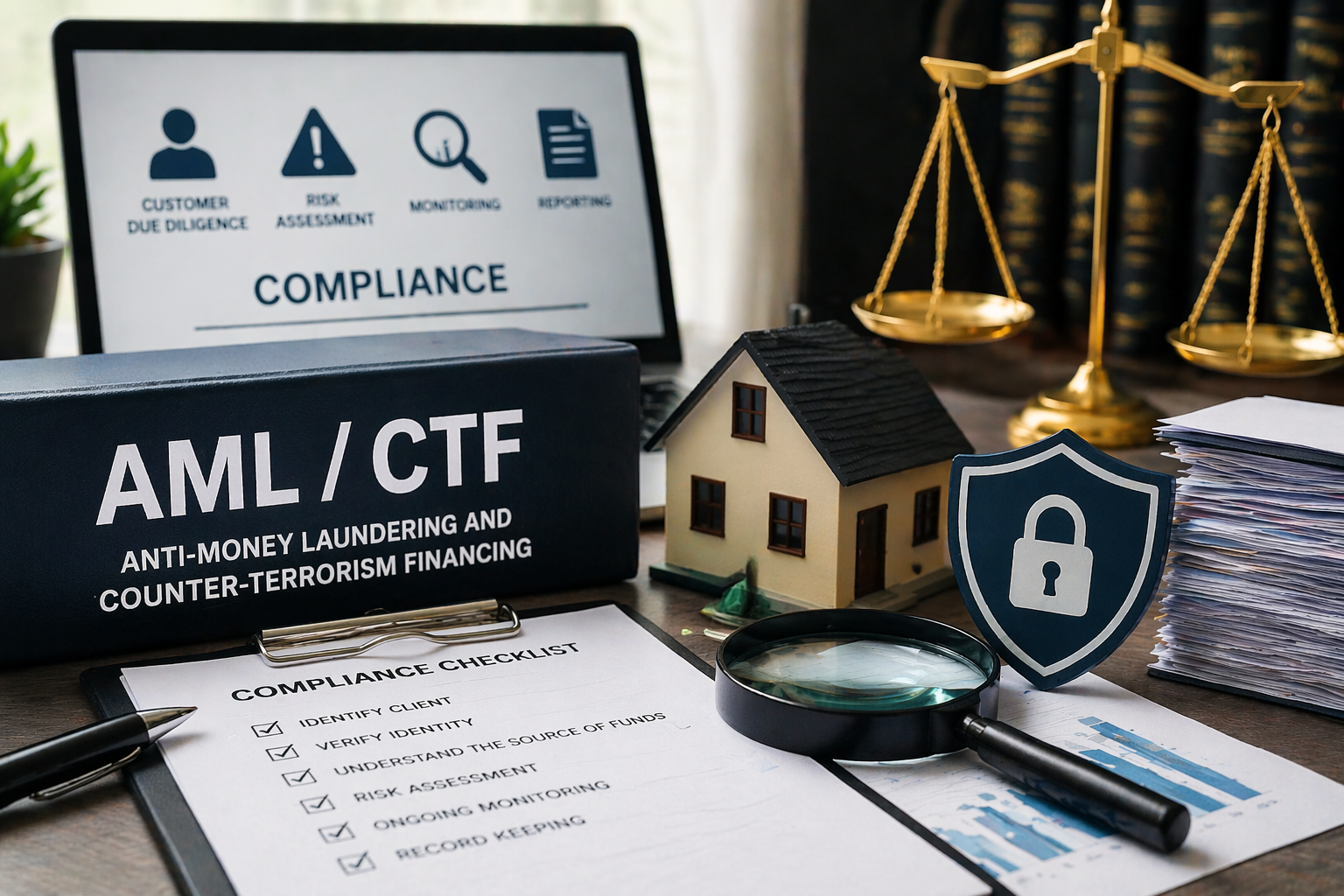
Depending on the service being provided, regulated businesses may need to:
- identify and verify clients;
- understand who ultimately owns or controls a company, trust or other entity;
- assess the money-laundering and terrorism-financing risk associated with a matter;
- conduct further checks where a transaction presents higher risk;
- maintain an AML/CTF compliance program and appropriate records; and
- make required reports to AUSTRAC where the legal reporting threshold is met.
Whether a particular legal service is regulated depends on the nature of the work being performed. The rules should therefore not be described as applying identically to every legal matter.
What buyers and sellers may be asked to provide
Buyers and sellers should be prepared to provide information and documents earlier in the transaction. The exact requirements will depend on the client, ownership structure, funding arrangement and risk profile of the matter.
Common requests may include:
- a passport, driver licence or other identification documents;
- evidence of the client’s residential address;
- company searches, constitutions or corporate authority documents;
- trust deeds and documents identifying trustees, appointors or beneficiaries;
- information about the individuals who ultimately own or control an entity;
- bank statements or loan documents showing how a deposit or purchase price is being funded;
- documents concerning gifted funds, private loans or family assistance; and
- an explanation of unusual payment arrangements or third-party contributions.
A lawyer or conveyancer may also need to ask follow-up questions where the information provided is incomplete, inconsistent or does not adequately explain the parties, ownership structure or movement of funds.
Source of funds and source of wealth are not the same thing
Clients may hear both terms during a property transaction, but they address different questions.
Source of funds
Source of funds generally concerns the immediate origin of the money being used in the transaction. Examples may include:
- money held in a savings account;
- proceeds from the sale of another property;
- bank finance;
- a family gift;
- a private loan; or
- funds transferred from an overseas account.
Source of wealth
Source of wealth is broader. It concerns how a person accumulated their overall financial position or assets, for example through employment, business ownership, investment income, inheritance or the sale of assets.
Not every matter will require the same level of enquiry. More complex or higher-risk transactions may require more extensive supporting evidence.
Transactions that may require additional preparation
Additional checks may be required where a property is being purchased or sold through:
- a company;
- a family trust or unit trust;
- a self-managed superannuation fund;
- a partnership or joint venture;
- an overseas entity;
- a nominee or agency arrangement; or
- a structure involving several layers of ownership or control.
Other circumstances that may require further explanation include third-party payments, gifted deposits, private finance, overseas transfers and payments from accounts that are not held in the client’s name.
These arrangements are not necessarily improper. However, they may require more documentation so that the professionals involved can understand the transaction and complete any applicable compliance steps.
Can AML/CTF checks delay a property transaction?
They can create delay where documents are requested late, ownership structures are unclear or the funding arrangement has not been properly explained.
Queensland contracts frequently contain strict dates for deposits, finance, due diligence and settlement. AML/CTF checks do not automatically extend those contractual deadlines.
Buyers and sellers should therefore provide requested information as early as possible rather than waiting until immediately before settlement.
A delay may be particularly difficult where:
- trust or company documents cannot be located;
- the beneficial owners of an entity have not been clearly identified;
- funds are arriving from several people or accounts;
- money is being transferred from overseas;
- a family contribution has not been documented as a gift or loan; or
- information supplied to different professional advisers is inconsistent.
A practical document checklist
Before commencing a Queensland property transaction, buyers and sellers should consider preparing the following documents where relevant:
- current photographic identification;
- proof of residential address;
- company and trust documents;
- documents confirming authority to act for an entity;
- bank statements showing the accumulation or transfer of funds;
- loan approval or finance documents;
- sale contracts or settlement statements from an earlier asset sale;
- gift letters or private loan agreements;
- inheritance or estate documents; and
- certified translations where relevant documents are not in English.
The documents required in an individual matter may differ. Clients should follow the specific requests made by their lawyer or conveyancer rather than assuming that the checklist is exhaustive.
What if a client does not provide the requested information?
Lawyers and conveyancers must comply with their legal and professional obligations. In some circumstances, a regulated professional may be unable to commence or continue providing a designated service until the required information has been obtained and assessed.
A professional may also be restricted from explaining whether a particular report has been or may be made to AUSTRAC.
Clients should not interpret a request for information as a personal allegation. The request may simply be part of the firm’s standard risk-based compliance process.
What overseas buyers should consider
Overseas buyers may face several separate legal and compliance processes. AML/CTF checks do not replace:
- Foreign Investment Review Board approval requirements;
- Queensland additional foreign acquirer duty considerations;
- foreign purchaser land tax considerations;
- identity and verification-of-authority requirements;
- banking and international transfer requirements; or
- the usual contract, finance and settlement obligations.
A buyer should obtain advice before signing an unconditional contract, particularly where FIRB approval or another regulatory approval may be required.
What Queensland buyers and sellers should do now
- Engage your lawyer early. Do not wait until immediately before signing or settlement.
- Explain the ownership structure. Tell your lawyer whether the transaction involves a company, trust, SMSF, nominee, overseas person or third-party contributor.
- Organise funding documents. Be ready to explain how the deposit and balance purchase price will be paid.
- Document family assistance. Clarify whether money from a relative is a genuine gift or a repayable loan.
- Allow additional time. Complex structures and overseas funding may require further enquiries.
- Keep information consistent. Details provided to the lender, accountant, agent and lawyer should not conflict.
How Ensure Legal can assist
Ensure Legal advises buyers, sellers, investors and businesses on Queensland property transactions, including contract review, conveyancing, commercial property, property development and foreign investment matters.
Early advice can help identify contractual, ownership, funding and regulatory issues before they place a transaction timetable under pressure.
Contact Ensure Legal to discuss your Queensland property transaction.
Disclaimer: This article provides general information only and does not constitute legal advice. AML/CTF obligations depend on the particular service, client and transaction. Obtain advice about your specific circumstances.


