

A renovated kitchen, enclosed patio, new deck or additional bedroom can make a property considerably more attractive.
But before signing a contract, there is another question buyers should ask:
Was the work actually approved?
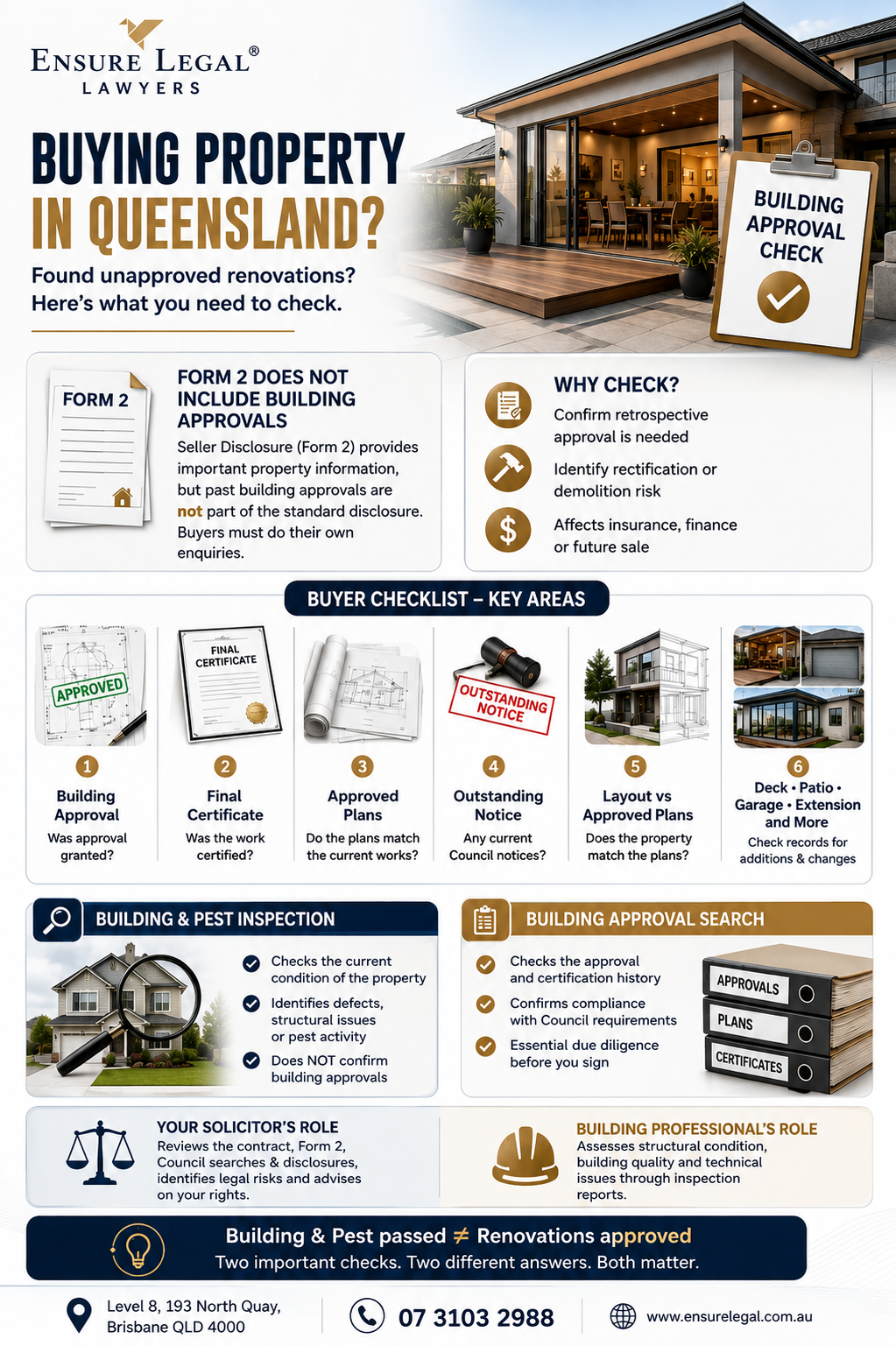
In Queensland, previous building or development approvals are not among the matters automatically disclosed through the standard Form 2 Seller Disclosure Statement. The prescribed disclosure warning specifically encourages buyers to make their own enquiries about building approvals before signing a contract.
That distinction is important.
A renovation may look professionally completed and may have existed for years, but its physical appearance alone does not establish that the appropriate approval, inspections and final certification were obtained.
For buyers, this makes building approval searches an important part of property due diligence, particularly where the property has obvious extensions or substantial alterations.
What Is “Unapproved Building Work”?
Building work in Queensland may require building approval and certification depending on the type and scope of the project.
Examples that may raise approval questions include:
- house extensions;
- additional rooms;
- decks and balconies;
- patios and enclosed outdoor areas;
- garages and carports;
- sheds;
- swimming pools;
- structural alterations; and
- conversions of existing spaces to a different use.
QBCC states that property owners are responsible for ensuring the appropriate building approvals are in place before relevant work begins, and that certain stages of building work must be inspected and certified.
Accordingly, there are several different situations a buyer may encounter.
The work might have:
- received the required approval and final certification;
- received an approval but have incomplete inspection or certification records;
- been constructed differently from the approved plans; or
- been carried out without the required approval.
Each situation requires a different analysis.
Form 2 Does Not Confirm That Renovations Are Approved
Queensland’s mandatory seller disclosure scheme commenced on 1 August 2025.
Under the scheme, sellers generally provide the buyer with a Seller Disclosure Statement (Form 2) and prescribed certificates before the buyer signs the contract.
The disclosure covers important matters such as title details, certain encumbrances, zoning and specified statutory notices.
However, the Queensland Government specifically identifies current or previous building and development approvals as information that does not have to be included in Form 2.
The prescribed Form 2 warning goes further. It tells buyers that the seller does not warrant that buildings on the property have the required approvals and encourages buyers to undertake searches to determine whether buildings and improvements have been properly approved.
This means:
Receiving a completed Form 2 does not replace building approval due diligence.
This is particularly important where the physical property clearly shows evidence of substantial renovations.
Example: The “Extra Bedroom” That Does Not Appear on the Plans
Consider a buyer purchasing a Brisbane house advertised as having four bedrooms.
During inspection, everything appears normal.
After settlement, the buyer discovers that the fourth bedroom was created by enclosing part of a veranda several years earlier.
A Council building search shows approvals for the original three-bedroom house, but there is no obvious approval corresponding with the enclosed area.
At that point, the buyer may need to investigate:
- whether approval was required;
- whether an approval exists under another description or historical record;
- whether the completed work matches any approved plans;
- whether certification was completed;
- whether retrospective approval or other compliance action is available; and
- what contractual or other rights may exist against the seller.
The key issue is that these questions are much easier to investigate before settlement.
How Can a Buyer Check Building Approvals?
The available searches depend on the local government area.
For property in Brisbane, Brisbane City Council currently offers several useful building searches.
1. Building Records Search
A building records search provides a list of building approvals recorded for the property, including the application number, description of the proposed work and approval date. Brisbane City Council states that its records can date back to 1946.
This can help answer questions such as:
“Was there ever an approval for this extension?”
2. Final Certification Search
An approval is only part of the picture.
For detached houses and associated structures, Council provides a building inspection search showing recorded building inspection or final inspection dates for each building approval. Different certificate searches apply to other classes of building.
This can help identify situations where an approval exists but the available records do not clearly show completion of the certification process.
3. Building Property Notice Search
Brisbane City Council also offers a search for outstanding building property notices issued under the Building Act 1975 and Planning Act 2016.
This can be particularly important because an existing compliance or enforcement issue may materially affect a buyer’s decision to proceed with the purchase.
4. Approved Plans and Building Documents
A buyer may also need the actual approved plans rather than simply a list of approvals.
Brisbane City Council can provide available documents including approved architectural or structural plans, site plans, decision notices, engineering certificates and final certificates. A buyer with a signed contract can use that contract as evidence when requesting relevant building documents.
This makes it possible to compare:
what Council approved
with
what is physically standing on the property today.
Approval and Final Certification Are Different Questions
A common mistake is to find an old building approval and stop investigating.
An approval generally establishes that proposed work was approved.
Certification deals with whether the work progressed through the required inspection and certification process.
QBCC explains that building certifiers assess plans, conduct required inspections and provide certification relating to the completed work.
For this reason, when reviewing a renovated property, useful questions include:
- Was the work approved?
- What exactly did the approved plans permit?
- Was the work inspected?
- Was final certification completed?
- Does the existing building match the approved plans?
A file showing an approval for a 20-square-metre deck does not automatically answer questions about a much larger enclosed room now occupying the same area.
What Happens If Unapproved Work Is Discovered After Settlement?
This is where the legal issue becomes more complicated.
Responsibility cannot be determined simply by asking:
“Who originally built it?”
Once a purchaser becomes the registered owner, unresolved building compliance issues can have practical consequences for that owner.
Queensland legislation gives local government enforcement powers in relation to certain unlawful or non-compliant building work. Depending on the circumstances, an enforcement notice can require steps including applying for an approval, rectifying or securing work and, in appropriate cases, removing or demolishing a structure.
A purchaser who discovers an issue after settlement may therefore have two separate questions:
- What needs to be done to bring the property into compliance?
- Does the purchaser have any contractual or other legal rights against the seller or another party?
The answers depend on the contract, seller representations, disclosure documents, searches undertaken before purchase, the nature of the work and the particular compliance issue.
There is no single rule that automatically transfers every financial consequence back to the person who originally performed the renovation.
Does Form 2 Give the Buyer a Right to Terminate?
The Queensland seller disclosure scheme gives buyers termination rights in certain circumstances where required disclosure is missing, inaccurate or incomplete. Where inaccurate or incomplete information is involved, statutory conditions concerning materiality and the buyer’s knowledge must also be satisfied.
However, building approvals require particular care because historical building and development approvals are expressly excluded from the information ordinarily required in Form 2.
A buyer therefore should not assume that discovering an unapproved renovation automatically creates a Form 2 termination right.
The particular contract and circumstances need to be reviewed.
This is one reason approval investigations are often most valuable before the contract becomes unconditional or before settlement occurs.
Can Unapproved Work Be Approved Retrospectively?
Depending on the type of work and circumstances, there may be processes available to address work that has already been completed.
However, retrospective compliance should not be treated as an automatic or purely administrative outcome.
The existing structure may need to satisfy applicable planning, siting, building and technical requirements, and additional professional reports or rectification work may be required.
For example, Brisbane City Council expressly recognises retrospective development applications within its development assessment framework, although such applications do not qualify for its streamlined RiskSMART process.
In the specific owner-builder context, QBCC also has a process dealing with owner-builder work already completed without the required permit. QBCC notes that such situations may require an application to the relevant assessment manager for development approval and can involve a fine.
Accordingly, buyers should avoid assuming:
“We can just get retrospective approval after settlement.”
The cost, timing and feasibility should be investigated first.
What Should Buyers Check Before Signing?
Where a property contains renovations, extensions or additional structures, buyers should consider whether the following due diligence is appropriate:
📑 1. Review the Contract and Form 2
Check the seller disclosure documents, statutory notices and any contractual statements about structures or improvements.
🏠 2. Identify What Has Actually Been Added or Altered
Walk through the property and identify obvious changes such as:
- enclosed patios;
- decks;
- extra bathrooms;
- additional bedrooms;
- converted garages;
- carports;
- sheds;
- pools; and
- extensions.
🔎 3. Conduct Council Searches
Check available building approval, certification and property notice records.
For Brisbane properties, Council specifically provides building approval, final certification and building property notice searches for buyers and property researchers.
📐 4. Compare Plans With the Existing Property
Where appropriate, obtain approved plans and compare them with the physical property.
🧱 5. Obtain Building Advice
Legal due diligence and physical building inspections perform different functions.
A solicitor can assist with the contract, searches, disclosure and legal consequences. A qualified building professional can assess structural condition and technical building issues.
⚖️ 6. Consider a Special Condition Before Signing
Where approval status remains uncertain, the buyer may wish to obtain legal advice about whether the contract should contain an appropriate due diligence or building-approval condition.
The wording and suitability of any condition will depend on the particular transaction.
Sellers Should Check Their Renovation History Too
The issue is equally relevant to sellers.
If you have added a deck, enclosed a patio, converted a garage or completed another substantial alteration, locating approval and certification records before putting the property on the market can help identify issues early.
Queensland’s Form 2 disclosure regime does not convert every historical approval into a mandatory disclosure item, but certain existing statutory notices under building and planning legislation may form part of the prescribed disclosure material.
Early review also gives the seller more time to investigate incomplete records or obtain professional advice where the physical property differs from the available approvals.
Discovering the issue after a buyer has raised it immediately before settlement generally leaves far fewer practical options.
How Can a Property Lawyer Help?
A property solicitor is not responsible for determining whether a deck is structurally sound or whether engineering work complies technically with the building standards.
The solicitor’s role is different.
For a buyer, legal assistance can include:
- reviewing the contract before signing;
- reviewing Form 2 and prescribed disclosure documents;
- advising on appropriate property searches;
- reviewing relevant Council search results;
- identifying contractual risks;
- considering appropriate special conditions;
- advising on issues discovered before settlement; and
- considering contractual or statutory options where a problem emerges.
For a seller, a solicitor can help identify the legal documents and disclosures relevant to the transaction before the contract is entered into.
The strongest property due diligence usually combines legal review with appropriate building, planning and technical investigations.
The Key Point: Check Before You Sign
An attractive renovation adds value only when the buyer understands what they are actually purchasing.
In Queensland, Form 2 does not provide a complete history of building and development approvals, and the prescribed disclosure regime specifically places buyers on notice to undertake their own enquiries about those matters.
If the property contains a major extension, deck, patio, additional room or other alteration, consider checking the approval and certification history before committing to the purchase.
A relatively simple search before signing can identify an issue that may otherwise become considerably more complicated after settlement.
Buying or Selling a Renovated Property in Queensland?
安信法律 Ensure Legal can assist Queensland buyers and sellers with contract review, seller disclosure, property searches, due diligence and legal issues involving renovations and building approvals.
If you have questions about a property’s approval history, obtaining advice before signing the contract gives you the greatest opportunity to investigate the issue and structure the transaction appropriately.
Disclaimer: This article provides general information only and does not constitute legal, building, planning, engineering or financial advice. Building approval requirements, contractual rights and compliance obligations depend on the particular property, local government area, work undertaken, applicable legislation and terms of the contract. Obtain advice relevant to your circumstances before entering into a property transaction.


