

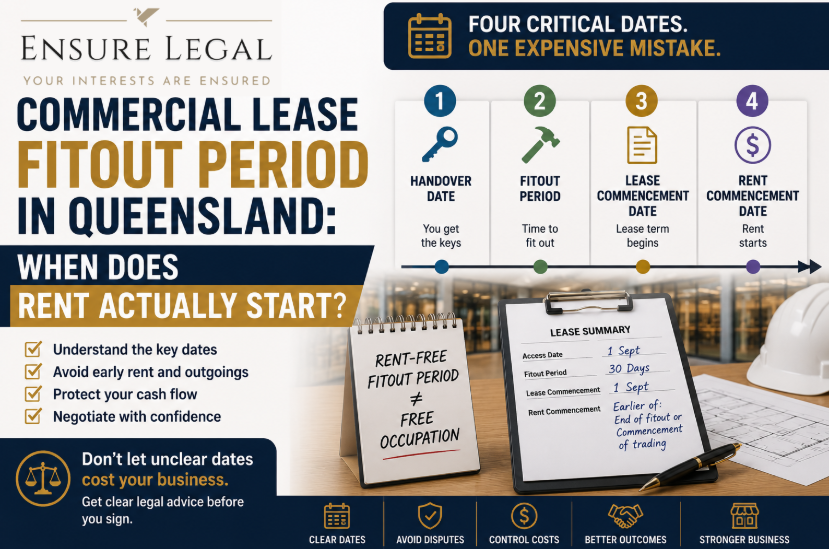
“30 Days Rent-Free for Fitout” Does Not Always Mean 30 Days Free
You negotiate a commercial lease for new premises.
The landlord agrees to give you:
30 days for fitout before rent starts.
You collect the keys on 1 September.
Your contractors move quickly and the business opens on 20 September.
You assume your rent still starts on 1 October because you were promised a 30-day fitout period.
Then the landlord issues a rent invoice from 20 September.
Who is correct?
The answer depends on the lease.
A clause may provide that rent begins on:
- a fixed date;
- the end of the fitout period;
- the date the tenant starts trading;
- the earlier of those dates; or
- another event defined in the lease.
That is why commercial tenants should distinguish between access, fitout, commencement and rent commencement before signing.
Queensland Government guidance specifically recommends checking when a business lease starts, what additional expenses are payable and what conditions apply to alterations and fitout before committing to the lease.
Four Dates That Tenants Should Keep Separate
A commercial lease transaction can involve several different dates.
1. Access or Handover Date
This is generally the date the tenant receives access to the premises.
It may allow the tenant to:
- measure the premises;
- bring in contractors;
- undertake fitout works;
- install equipment;
- connect services; or
- prepare for opening.
Receiving the keys does not necessarily mean that every financial obligation under the lease starts on the same day.
The early-access document or lease should explain exactly what the tenant may do during this period and which obligations already apply.
2. Fitout Period
The fitout period is the time allowed for the tenant to prepare the premises for business.
Depending on the business, this may involve:
- partitions;
- flooring;
- cabinetry;
- electrical works;
- plumbing;
- air-conditioning;
- signage;
- kitchen equipment;
- fire services;
- furniture;
- data and communications; or
- specialist equipment.
There is no single standard fitout period that applies to every Queensland commercial lease. The length and financial treatment of the period depend principally on what the parties negotiate and document.
3. Lease Commencement Date
The lease commencement date usually marks the beginning of the contractual lease term.
For example:
Lease commencement: 1 September 2026
Lease term: 5 years
The contractual expiry date may therefore be calculated from 1 September even where base rent begins later.
This distinction matters when calculating:
- expiry;
- option dates;
- rent reviews;
- bank guarantee expiry;
- insurance requirements; and
- other time-based obligations.
For a Queensland retail shop lease, there is an additional statutory consideration. The Retail Shop Leases Act 1994 treats a retail shop lease as entered into on the earliest of:
- the date by which all parties have signed;
- the date the tenant enters into possession under the lease; or
- the date the tenant first pays rent, excluding a deposit merely paid to secure the premises.
That statutory concept should not be confused with the particular contractual dates defined in the lease.
4. Rent Commencement Date
This is the date from which the tenant becomes liable to pay base rent.
It may be:
- the same as the lease commencement date;
- after a rent-free fitout period;
- triggered by completion of landlord works;
- triggered by opening for trade; or
- determined under another formula.
This is often the date tenants focus on most—but it should be read together with the other dates.
Example: Opening Early Can Trigger Rent Early
Consider the following lease:
Handover Date: 1 September
Fitout Period: 30 days
Rent Commencement Date: the earlier of:
- expiry of the fitout period; and
- the date the tenant opens for trade.
The tenant completes the fitout quickly and opens on:
20 September
Under that wording, rent would commence on 20 September, rather than 1 October.
The tenant has received up to 30 days for rent-free fitout, rather than an unconditional 30-day rent-free period.
That difference should be identified before signing the Heads of Agreement or lease.
A Fitout Period Is Not Necessarily a Rent-Free Period
These expressions are sometimes used casually as though they mean the same thing.
They do not necessarily.
A lease might provide:
Tenant may access the premises for 30 days before commencement to carry out fitout works.
That tells you something about access.
It does not necessarily answer whether the tenant must pay:
- rent;
- outgoings;
- electricity;
- water;
- air-conditioning charges;
- insurance;
- security costs; or
- other occupancy expenses
during those 30 days.
Business Queensland warns commercial tenants to look beyond base rent and identify all additional tenancy costs, including outgoings, energy, insurance, repairs and other expenses.
A properly drafted arrangement should state exactly what is free and what remains payable.
“Rent-Free” May Still Mean Outgoings Are Payable
This is another common source of misunderstanding.
Suppose a landlord grants:
6 weeks rent-free for fitout.
The tenant may read that as:
“Nothing is payable for six weeks.”
But the lease or incentive deed may only waive base rent.
The tenant could still be liable for amounts such as:
- outgoings;
- utilities;
- waste services;
- air-conditioning;
- insurance contributions; or
- other charges
depending on the lease.
The correct question is therefore:
What exactly is being waived during the fitout period?
rather than simply:
Is there a rent-free period?
Landlord Works Should Be Linked to Handover
Many commercial leases require the landlord to complete works before the tenant begins fitout.
Examples include:
- installing services;
- constructing walls;
- completing base-building works;
- providing electrical capacity;
- installing air-conditioning;
- repairing the roof;
- upgrading amenities;
- removing the previous tenant’s fitout; or
- obtaining particular approvals.
The risk for a tenant arises where the fitout period starts on a fixed date even though the landlord has not finished those works.
For example:
Fitout starts: 1 September
Rent starts: 1 October
But on 1 September:
- the electrical upgrade is incomplete;
- the premises are still occupied by contractors; and
- the tenant cannot begin its own fitout.
If the lease contains no adjustment mechanism, the tenant may lose part of the negotiated fitout period.
A more carefully structured lease might link the fitout period to an agreed handover condition, practical completion of landlord works, or another objectively identifiable event.
What If Landlord Works Are Delayed?
The lease should ideally answer:
- Who determines when landlord works are complete?
- Does the tenant inspect before accepting handover?
- What happens if minor defects remain?
- Is the fitout period extended for landlord-caused delay?
- Does the rent commencement date move?
- Is there a long-stop date?
- Can the tenant terminate if the premises are not ready by that date?
There is no universal answer across all commercial leases.
It depends on the drafting.
This is why vague wording such as:
“Approximately four weeks’ fitout period”
can create unnecessary disputes.
Dates, triggers and consequences should be stated clearly.
What If Council Approval or a Licence Is Delayed?
This can create an even greater financial risk.
Imagine a tenant plans to operate a restaurant.
The lease permits the premises to be used as a restaurant and provides:
Rent commencement: 1 November
The tenant completes the physical fitout, but a necessary approval or licence is still pending.
Can the tenant delay rent until the business opens?
Only if the lease or another binding agreement provides appropriate protection.
A lease clause allowing a particular permitted use does not itself guarantee that the tenant has all planning, building or regulatory approvals required to conduct the business.
Business Queensland specifically recommends checking Council approvals before entering into a commercial lease and notes that leases commonly place responsibility for those approvals on the tenant.
For businesses requiring substantial approvals, tenants should consider whether the transaction needs to be conditional upon matters such as:
- development approval;
- building approval;
- food business licence;
- liquor licence;
- signage approval;
- body corporate consent; or
- other industry-specific approvals.
Otherwise, rent may begin while the tenant is still unable to trade.
Early Access Can Create Obligations Before Rent Starts
A tenant receiving the keys early should also understand the conditions attached to that access.
Even where base rent has not commenced, the tenant may already have obligations concerning:
- insurance;
- workplace safety;
- contractor conduct;
- damage to the premises;
- indemnities;
- fitout approvals;
- compliance with building rules;
- utilities; and
- access procedures.
An early-access arrangement should therefore be documented.
Ensure Legal’s existing commercial leasing guidance already identifies pre-lease documents and early access as matters that should be clearly addressed before a tenant takes possession.
The Fitout Period Can Affect the Entire Lease Term
Tenants sometimes focus on the rent saving without considering what happens to the actual term.
Consider:
Lease commencement: 1 September 2026
Rent commencement: 1 October 2026
Term: 5 years from lease commencement
The lease may expire on:
31 August 2031
not 30 September 2031.
The tenant therefore receives one month without base rent, but that month is still part of the five-year lease term.
Another lease might instead define the lease commencement date as the rent commencement date.
The commercial result is different.
This can also affect:
- option exercise periods;
- market rent review dates;
- fixed increases;
- incentive calculations; and
- make-good planning.
What About a Lease Incentive?
A fitout period may form only one part of a larger incentive package.
For example:
5-year lease
Landlord provides:
- 4 weeks’ fitout access;
- 2 months’ rent-free period;
- $100,000 fitout contribution.
Those three benefits should be distinguished clearly.
The incentive documentation should address:
- when each benefit starts;
- whether outgoings remain payable;
- how the fitout contribution is claimed;
- evidence required before reimbursement;
- whether GST applies;
- whether the incentive is conditional upon the tenant opening;
- what happens if the tenant defaults; and
- whether any clawback provisions apply.
A large headline incentive can be much less valuable if the triggering dates and conditions are poorly understood.
Example: The Café That Starts Paying Before It Opens
Suppose a café tenant negotiates:
Access: 1 August
Fitout period: 6 weeks
Rent commencement: 15 September
The tenant expects to open on 15 September.
During fitout, the tenant discovers that additional plumbing and exhaust works are required.
Opening is delayed until:
15 October
The lease still states that rent starts on 15 September.
Unless another clause provides relief, the tenant may face:
- rent;
- outgoings;
- wages;
- financing costs; and
- further construction expenses
for a month before earning trading revenue.
This is why the rent commencement mechanism should be assessed alongside the fitout program—not after delays arise.
Should Rent Start When the Business Starts Trading?
Tenants often prefer this arrangement.
But landlords may resist an open-ended clause because the tenant could potentially control the opening date.
A negotiated provision may therefore use:
the earlier of:
- the tenant opening for trade; and
- a fixed long-stop date.
This gives the tenant an opportunity to open earlier while giving the landlord certainty that rent will start by a particular date.
The commercial suitability depends on the project.
Retail Shop Tenants Have Additional Protections
Where the lease is governed by the Retail Shop Leases Act 1994 (Qld), additional statutory requirements apply.
One particularly important rule is that a retail shop lease may be treated as entered into before the formal lease commencement date if the tenant takes possession or first pays rent.
Retail leases are also subject to statutory requirements concerning disclosure, outgoings, rent reviews and other matters.
This means retail tenants should not assume that:
“The formal commencement date hasn’t arrived, so the retail leasing legislation does not apply yet.”
The statutory definition may produce a different result.
What Should Be Written into the Heads of Agreement?
The best time to clarify fitout dates is often before the formal lease is drafted.
A Heads of Agreement or Offer to Lease should consider specifying:
Access Date
When can the tenant enter?
Handover Condition
What must the landlord complete before access?
Fitout Period
How many days or weeks are allowed?
Lease Commencement Date
When does the contractual term begin?
Rent Commencement Date
When does base rent start?
Outgoings Commencement
When do operating expenses become payable?
Early Trading
Does opening early trigger rent?
Landlord Delay
Does landlord-caused delay extend the fitout or rent-free period?
Approval Delay
Who carries the risk if Council or licensing approvals take longer than expected?
Long-Stop Date
What happens if the premises are still not ready by a specified date?
Agreeing these points early makes the formal lease much easier to negotiate.
Tenant Checklist Before Starting Fitout
Before ordering equipment or sending contractors to the premises, tenants should check:
- When do I legally receive access?
- What works am I allowed to carry out?
- Has the landlord approved my fitout plans?
- Are Council or other approvals required?
- When does the fitout period start?
- When does it end?
- When does rent start?
- When do outgoings start?
- Does opening early trigger rent?
- What happens if landlord works are late?
- What insurance must already be in place?
- Who owns the fitout at the end of the lease?
- What must I remove under the make-good clause?
Business Queensland recommends investigating lease terms carefully before signing because lease commitments can have significant financial consequences for a business.
Landlords Should Define the Dates Clearly Too
Unclear drafting creates risk for landlords as well.
A landlord should be able to identify:
- when possession is given;
- whether early access is a licence or possession under the lease;
- what the tenant can do during fitout;
- whether rent is waived;
- whether outgoings remain payable;
- who is responsible for fitout damage;
- what happens if the tenant opens early;
- when the formal term begins; and
- what occurs if either party’s works are delayed.
This can prevent disputes over whether the tenant received the full incentive promised during negotiations.
The Four-Date Rule
A simple way to review a commercial lease is to write these four dates on one page:
1. ACCESS DATE
When do I get the keys?
2. FITOUT PERIOD
How long do I have to prepare the premises?
3. LEASE COMMENCEMENT DATE
When does the contractual term begin?
4. RENT COMMENCEMENT DATE
When does my rent liability begin?
Then add a fifth question:
When do OUTGOINGS start?
If those answers are unclear, the lease should be clarified before signing.
Frequently Asked Questions
Is a fitout period automatically rent-free?
No. The lease or incentive arrangement should specify whether rent is waived and whether other amounts such as outgoings remain payable.
Does getting the keys mean rent starts immediately?
Not necessarily. Access, lease commencement and rent commencement may occur on different dates depending on the agreement.
For a retail shop lease, however, taking possession can be relevant to when the lease is treated as entered into under the Retail Shop Leases Act.
If I open early, can the landlord start charging rent?
Potentially, if the lease states that rent begins when the tenant starts trading or on the earlier of opening and another specified date.
What happens if the landlord’s works are late?
The lease should determine the consequences. Tenants should consider negotiating an extension of the fitout period, adjustment to rent commencement or a long-stop mechanism where landlord works are critical.
What happens if my business licence is delayed?
A delay in approval does not automatically postpone rent. The lease should be checked for any condition or mechanism dealing with approval delays.
Do I pay outgoings during a rent-free period?
Potentially. “Rent-free” may only refer to base rent. The lease and incentive documents should state whether outgoings and other charges remain payable.
The Key Point: Do Not Ask Only “How Much Is the Rent?”
For a new commercial tenancy, timing can be just as important as the rental rate.
A tenant who negotiates an attractive rent but loses weeks of fitout time—or starts paying before the business can open—may face a substantial cash-flow problem.
Before signing, identify:
when you get the keys,
when the fitout clock starts,
when the lease term starts,
when rent starts, and
when outgoings start.
Those dates should work together.
If they do not, the time to negotiate is before the lease and fitout commitments become fixed.
Entering a Commercial Lease in Queensland?
Ensure Legal assists Queensland landlords and tenants with:
- Offers to Lease and Heads of Agreement;
- commercial and retail lease review;
- fitout and early-access arrangements;
- landlord works;
- rent commencement clauses;
- lease incentives;
- outgoings;
- permitted use and approval issues;
- make-good obligations; and
- commercial leasing disputes.
If you are about to sign a lease involving significant fitout works, reviewing the dates and trigger clauses before work begins can help prevent rent and delay disputes later.
Disclaimer: This article provides general information only and does not constitute legal, financial, planning or building advice. Fitout periods, commencement dates, rent obligations, outgoings and delay consequences depend on the terms of the particular lease and surrounding circumstances. Specific professional advice should be obtained before entering into a commercial lease.


