

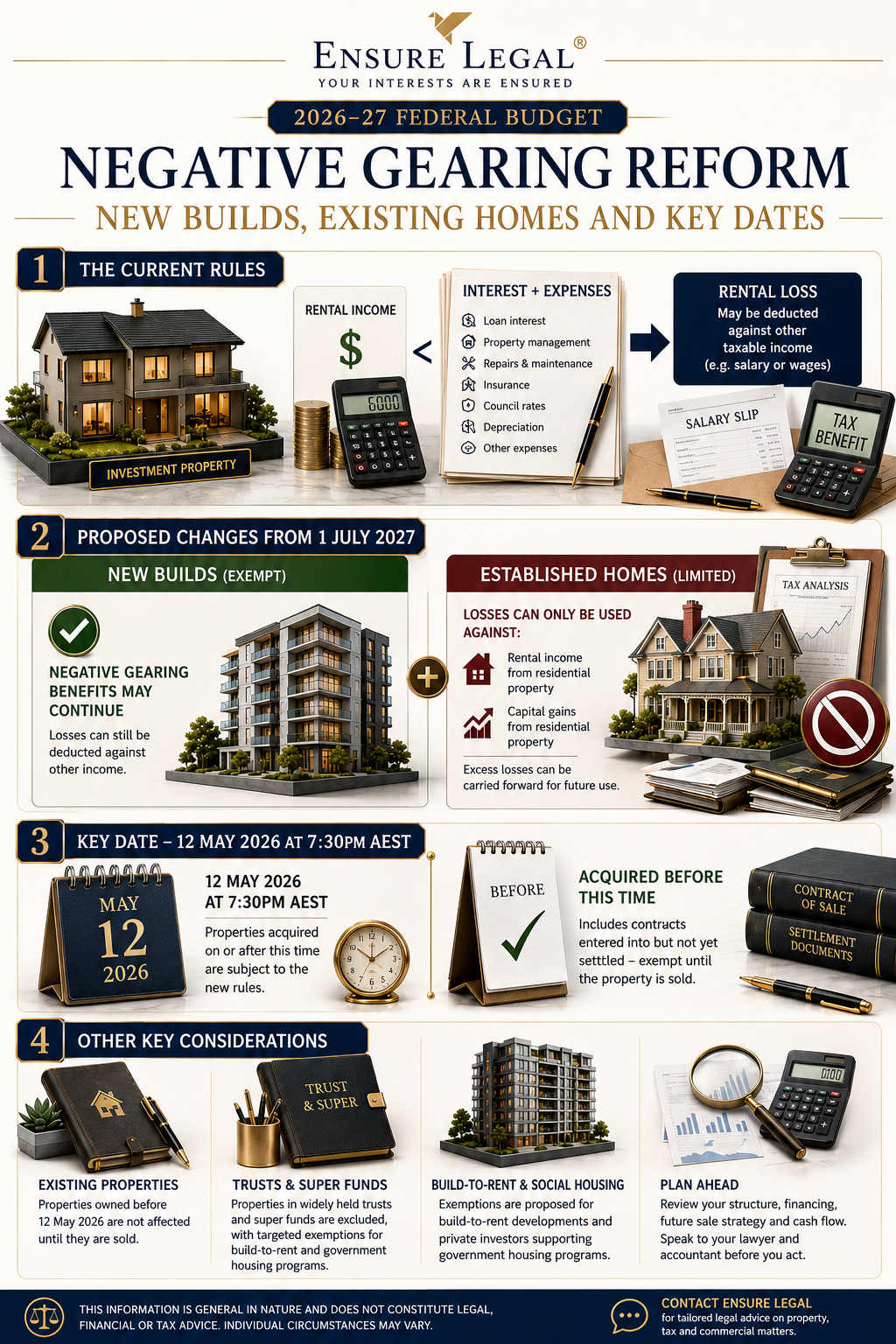
Negative gearing reform is back on the table
The Australian Government’s 2026–27 Federal Budget proposes a major change to how negative gearing applies to residential investment property.
For many property investors, negative gearing has long been part of the investment equation. Where rental income is less than deductible costs such as loan interest and other holding expenses, the resulting loss may currently be used to reduce other assessable income, depending on the investor’s circumstances.
The proposed reform does not abolish negative gearing entirely. Instead, it redirects the benefit towards new builds and limits the use of losses from established residential properties.
For high-net-worth families, property investors and buyers using trusts or complex ownership structures, the key issue is not only tax. It is also contract timing, asset structuring, purchase strategy, finance planning and exit risk.
What has the Government proposed?
According to Budget Paper No. 2, the Government will limit negative gearing for residential property to new builds. From 1 July 2027, losses from established residential properties will only be deductible against rental income or capital gains from residential properties. Excess losses may be carried forward and used against residential property income in future years.
This means the proposed system draws a sharper line between:
New residential property, where negative gearing benefits may continue; and
Established residential property, where losses may no longer be used broadly against other income such as salary or wages once the new limits apply.
The Government states that eligible new builds will be exempt from the new limits, with the stated policy objective of directing investment towards housing supply.
The key date: 12 May 2026 at 7:30pm AEST
The Budget papers specify that the changes will apply to established residential properties acquired from 7:30pm AEST on 12 May 2026. Properties acquired before that time, including contracts entered into but not yet settled, are proposed to be exempt from the changes until the property is disposed of.
This date is critical.
For investors, the legal question may not simply be “when did settlement occur?” It may also involve:
whether a binding contract was entered into before the cut-off time;
whether the property is properly characterised as an established residential property or a new build;
whether the buyer is an individual, trust, company, SMSF or other entity;
whether any nomination, assignment or change in purchaser may affect the treatment;
whether future restructuring could disturb the expected tax position.
These are not issues investors should leave until tax time. They should be checked before signing, restructuring or refinancing.
Established homes: what changes?
Under the proposed reform, if an investor acquires an established residential property after the relevant cut-off time, and the property produces a rental loss from 1 July 2027, that loss may be limited.
Instead of being available to offset broader income, the loss would generally be restricted to residential property income, including rental income or residential capital gains. Excess losses may be carried forward for future use.
For investors with multiple properties, this could materially affect cash flow.
A property that previously looked viable because the investor expected to offset losses against salary or business income may need to be re-tested under the proposed rules.
New builds: why they matter
The proposed reform is designed to preserve negative gearing benefits for eligible new builds. The Government’s stated aim is to direct tax benefits towards investment that increases housing stock.
This may change how investors compare:
new apartments;
new townhouses;
house-and-land packages;
newly constructed dwellings;
established houses;
renovation projects;
build-to-rent projects.
However, “new build” should not be treated as a casual label. Investors should check the contract, construction status, title details, completion timing, developer documentation and any tax advice before assuming a property qualifies.
What about trusts, super funds and build-to-rent?
The Budget papers state that properties in widely held trusts and superannuation funds will be excluded, alongside targeted exemptions for build-to-rent developments and private investors supporting government housing programs.
This is important for sophisticated investors.
Many high-net-worth families hold assets through trusts, companies, SMSFs or layered structures. The proposed negative gearing changes should be considered alongside broader Budget measures affecting capital gains tax and discretionary trusts.
A structure that worked well under existing settings may not produce the same result under the proposed rules.
Legal issues property investors should review
For property investors, this Budget measure is not only a tax issue. It may affect legal and commercial decisions before acquisition, during ownership and at exit.
Investors should review the following before making major decisions:
Contract timing: If relying on transitional treatment, evidence of when a binding contract was entered into may become important.
Property classification: Whether the property is a new build, established dwelling, build-to-rent project or other residential asset may affect the analysis.
Ownership structure: Individual ownership, family trusts, companies, SMSFs and joint ownership may produce different legal and tax outcomes.
Finance and cash flow: If losses can no longer offset salary or business income, borrowing capacity and after-tax holding costs may change.
Future sale strategy: Residential capital gains may become more important if carried-forward losses can only be used against residential property income.
Estate and succession planning: Long-held properties may be exempt until disposal, but transfers, restructures or succession events require careful planning.
Why this matters for Queensland property investors
Queensland investors, particularly in Brisbane, the Gold Coast, Sunshine Coast and growth corridors, should be careful when comparing new and established residential properties.
A high-yield established property may look attractive on paper, but the after-tax result may change if future losses cannot be used in the same way.
Similarly, a new build may carry different legal risks, including developer solvency, sunset clauses, body corporate costs, building defect issues, settlement timing and finance approval conditions.
A better investment decision requires both tax and legal due diligence.
What should investors do now?
The proposed negative gearing reform has not simply created a “buy new, avoid old” rule. The reality is more nuanced.
Investors should not rush into a purchase or sell an existing property purely because of a Budget announcement. Instead, they should review:
existing property holdings;
signed contracts and settlement dates;
family trust or company ownership structures;
finance arrangements;
future sale plans;
estate planning documents;
tax advice from their accountant or tax adviser.
For high-value property portfolios, small structuring mistakes can create significant long-term consequences.
Speak to Ensure Legal before signing or restructuring
Ensure Legal assists clients with property transactions, commercial matters and legal due diligence in Queensland.
Before purchasing, restructuring or transferring investment property, investors should obtain legal advice on the contract, ownership structure, settlement risks and related documentation. Tax advice should also be obtained from a qualified tax professional.
The 2026–27 Budget proposals may change the investment landscape, but the right response depends on the property, the buyer, the structure and the long-term plan.
This article is general information only and does not constitute legal, financial or tax advice. The proposed measures remain subject to legislation and individual circumstances.
Suggested FAQ section
What is negative gearing?
Negative gearing generally refers to a situation where the deductible costs of holding an investment asset exceed the income it produces. For rental property, this may occur where loan interest and other expenses exceed rental income.
Is negative gearing being abolished in Australia?
No. The 2026–27 Budget proposes to limit negative gearing for residential property to new builds. Established residential property losses would be restricted under the proposed rules from 1 July 2027.
When do the proposed negative gearing changes start?
The proposed limits are scheduled to apply from 1 July 2027, but they affect established residential properties acquired from 7:30pm AEST on 12 May 2026.
Are existing investment properties affected?
Properties acquired before 7:30pm AEST on 12 May 2026, including contracts entered into but not yet settled, are proposed to be exempt from the changes until disposed of.
Do the changes apply to new builds?
Eligible new builds are proposed to be exempt from the new negative gearing limits.
Should I buy a new build instead of an established home?
Not necessarily. Investors should consider tax treatment, contract terms, construction risk, body corporate costs, location, financing, rental demand and long-term exit strategy before deciding.


