


When buying, selling, leasing or developing property in Queensland, clients often see the word “disbursements” in a costs disclosure, quote, settlement statement or legal invoice.
Many people assume disbursements are simply another form of legal fees. They are not.
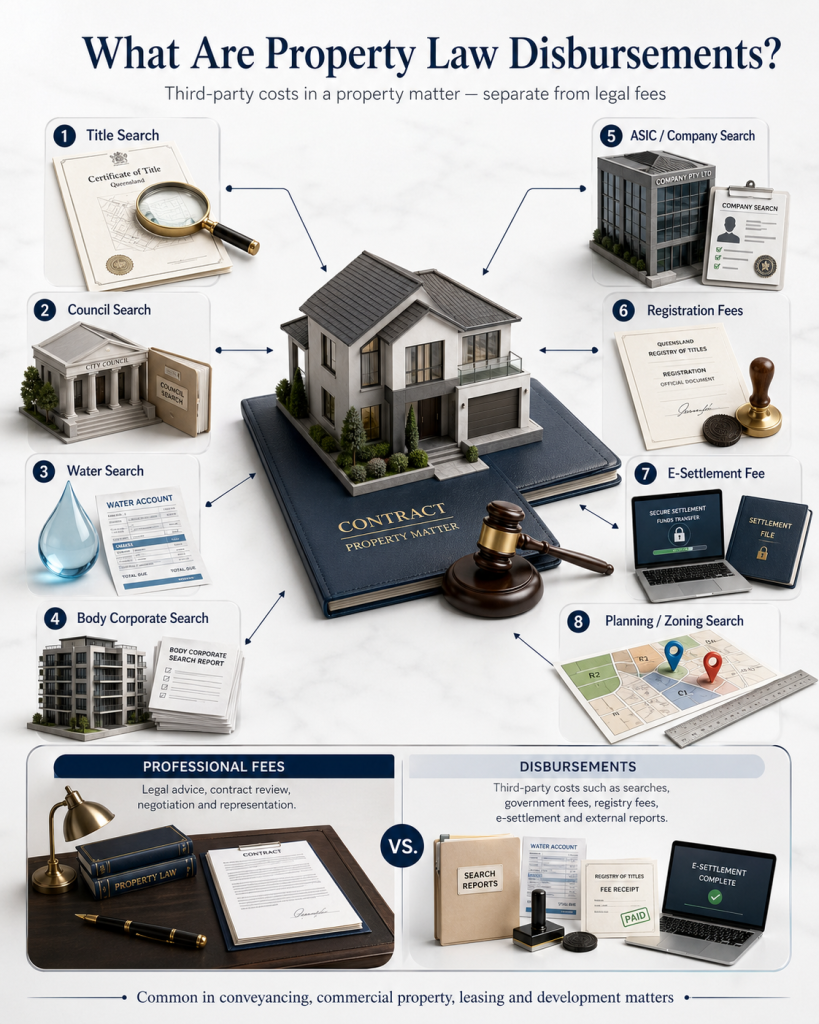
In property law, disbursements are usually third-party costs paid or incurred as part of your matter. They are separate from your lawyer’s professional fees. In a conveyancing or commercial property transaction, these costs can include title searches, council searches, water searches, registration fees, PEXA fees, body corporate records, company searches, planning searches, settlement fees and other property-related enquiries.
Understanding disbursements helps you budget properly and avoid surprises before settlement.
What does “disbursement” mean?
A disbursement is generally an amount paid to a third party in connection with your legal matter.
For example, if your property lawyer orders a title search from Titles Queensland, pays a government lodgement fee, orders a council rates search, or incurs a PEXA settlement fee, that cost may appear as a disbursement.
In simple terms:
Legal fees pay for the lawyer’s advice, drafting, negotiation and transaction management.
Disbursements pay for external costs needed to progress the matter.
In property law, disbursements are common because property transactions require information from government authorities, land registries, councils, water authorities, body corporates, electronic settlement platforms and other external providers.
Common property law disbursements in Queensland
The exact disbursements depend on the type of transaction. A simple residential conveyance will usually involve fewer disbursements than a commercial property acquisition, development site purchase or complex lease transaction.
Common examples include:
| Type of disbursement | What it relates to |
|---|---|
| Title search | Confirms registered owner, lot and plan details, mortgages, easements, caveats and other registered interests |
| Registered plan search | Shows the plan of survey and land description |
| Council rates search | Checks rates, charges and sometimes property-related council information |
| Water search | Checks water charges, usage and account information |
| Land tax search or clearance | Checks whether land tax may affect the property |
| Body corporate search | Relevant for apartments, townhouses, community title schemes and commercial strata property |
| Company or ASIC search | Often relevant where a buyer, seller, landlord or tenant is a company |
| PPSR search | May be relevant for business sales, plant, equipment, security interests or leased goods |
| Planning, zoning or flood searches | Often relevant for development sites, commercial property and higher-risk purchases |
| Registration or lodgement fees | Fees for registering transfers, mortgages, leases or other dealings |
| PEXA fee | Electronic settlement and lodgement fee |
| Settlement agent or agent attendance fee | May apply in some paper or non-standard settlements |
| Courier, postage or identity verification costs | Administrative or compliance-related costs |
Titles Queensland provides a fee calculator for lodgement fees, and notes that fees are updated each year on 1 July unless advised otherwise. It also notes that statutory fees are not subject to GST.
Disbursements in a property purchase
For a buyer, disbursements are usually connected with due diligence, settlement and registration.
A buyer may need searches to confirm:
- who owns the property;
- whether there are registered encumbrances;
- whether rates, water or land tax amounts need to be adjusted at settlement;
- whether the property is affected by body corporate issues;
- whether there are planning, zoning, flooding, infrastructure or contamination concerns;
- whether there are leases, easements, covenants or other interests affecting the land.
In Queensland, transfer duty may also be payable when buying, selling or transferring property. The Queensland Government describes transfer duty as a tax that may apply when property is bought, sold or transferred.
Transfer duty itself is not usually described as a solicitor’s professional fee. It is a government charge. Depending on the way a law firm presents its invoice or settlement statement, it may be shown separately from legal fees and disbursements because it is often one of the largest transaction costs.
Disbursements in a property sale
For a seller, disbursements may include title searches, plan searches, mortgage discharge-related costs, settlement platform fees, seller disclosure documents and other searches needed to prepare the transaction.
This has become especially important under Queensland’s seller disclosure regime.
Queensland’s seller disclosure scheme requires sellers to give buyers key information about a property before the contract of sale is signed. The Queensland Government’s guidance says sellers should collect up-to-date title and property documents, complete the Form 2 Seller Disclosure Statement, obtain required certificates and ensure disclosure is given properly and recorded.
This means sellers may need to incur disbursements before a contract is signed, not only after the property is sold.
For example, prescribed certificates may include title details, a title search, survey plan, relevant planning or environmental notices, pool compliance documents, body corporate documents and other required materials depending on the property.
Disbursements in commercial leasing
Disbursements are not limited to buying and selling property. They can also arise in commercial leasing.
For landlords and tenants, disbursements may include:
- title searches;
- company searches;
- ASIC extracts;
- body corporate searches;
- lease registration fees;
- mortgagee consent fees;
- plan searches;
- PPSR searches;
- courier or document execution costs;
- electronic lodgement costs, where applicable.
For example, if a commercial lease is to be registered on title, registration-related costs may arise. If the landlord is a company, trust or body corporate, additional searches or consents may be required.
In retail and commercial leasing, a small saving on upfront searches can become expensive later if the lease is signed without properly checking ownership, authority, title restrictions, mortgagee requirements or body corporate rules.
Disbursements in property development matters
Property development transactions often involve more complex disbursements because the legal work may involve site acquisition, due diligence, easements, development approvals, subdivision, infrastructure issues and staged settlements.
Common development-related disbursements may include:
- title and historical title searches;
- easement and covenant searches;
- registered plan and survey searches;
- zoning and planning enquiries;
- flood or overland flow searches;
- contaminated land or environmental searches;
- body corporate and community management statement searches;
- infrastructure or resumption-related enquiries;
- company, trust and PPSR searches;
- settlement and lodgement fees.
For development sites, disbursements should not be viewed as “extra paperwork”. They are often part of the risk-control process.
A title search may identify a registered easement. A planning search may reveal development constraints. A body corporate record may show levies, disputes or upcoming works. A contaminated land search may affect finance, value, use and exit strategy.
Why do disbursements vary so much?
Two property matters with the same purchase price can have very different disbursements.
The amount may depend on:
- whether the property is residential, commercial, industrial, rural or mixed-use;
- whether it is freehold, leasehold or community title;
- whether the matter involves a body corporate;
- whether the property is tenanted;
- whether there are mortgages, caveats, easements or encumbrances;
- whether the buyer needs finance;
- whether the seller must prepare disclosure documents;
- whether the transaction is settled electronically through PEXA;
- whether urgent searches are required;
- whether additional due diligence is needed.
PEXA explains that its Queensland fees are separate from statutory lodgement fees set by the relevant land registry, and that customers are charged per successful lodgement depending on the transaction type.
This is why clients should be cautious about comparing quotes based only on the headline legal fee. A quote with a lower professional fee may not include the same searches, disclosure work or settlement costs.
Are disbursements optional?
Some disbursements are practically necessary. Others are optional but recommended depending on risk.
For example:
- A title search is usually essential in a property transaction.
- A council rates search is commonly required for settlement adjustments.
- A body corporate search may be important for a unit, townhouse or commercial strata property.
- A planning or flood search may be optional in a simple transaction but critical for a development site.
- A PPSR search may be unnecessary for a basic house purchase but important in a business sale or asset-heavy transaction.
The key question is not simply “Can we avoid this cost?” but:
What legal or commercial risk are we accepting if we do not order this search or incur this disbursement?
A good property lawyer should explain which disbursements are standard, which are required, and which are recommended based on the specific transaction.
Disbursements vs adjustments at settlement
Clients sometimes confuse disbursements with settlement adjustments.
They are different.
Disbursements are costs incurred to progress the legal matter. Settlement adjustments are calculations between buyer and seller for items such as council rates, water charges, rent, land tax or body corporate levies.
For example, a water search fee may be a disbursement. The actual water usage adjustment at settlement is a settlement adjustment.
Both may appear in property transaction documents, but they are not the same thing.
How Ensure Legal helps clients understand disbursements
At Ensure Legal, our property law team assists clients with Queensland property transactions including conveyancing, commercial leasing, commercial property, property development, business sales and FIRB-related matters.
We help clients understand:
- what disbursements are likely to arise;
- why each search or external cost is needed;
- whether a search is standard, optional or risk-based;
- how disbursements affect settlement figures;
- whether additional searches are recommended before signing;
- how seller disclosure obligations may affect upfront costs;
- how disbursements differ from legal fees, duty and settlement adjustments.
Property transactions are often time-sensitive. A modest search cost may help identify a major issue before a contract becomes unconditional, before a lease is signed, or before settlement takes place.
Key takeaway
Disbursements are a normal part of property law matters. They are not simply “extra legal fees”. They are usually third-party costs incurred to obtain searches, documents, registrations, certificates, settlement services or government information required for the transaction.
For buyers, disbursements help support due diligence.
For sellers, they may be needed to prepare disclosure and settlement documents.
For landlords and tenants, they may assist with lease review, registration and authority checks.
For developers and investors, they can be central to risk management.
Before signing a contract, lease or property transaction document, it is important to understand not only the legal fee, but also the likely disbursements and transaction costs.
Need help with a Queensland property matter?
Ensure Legal assists with conveyancing, commercial leasing, commercial property transactions, property development, business sales and FIRB-related property matters in Queensland.
Contact Ensure Legal to discuss your property transaction before you sign, settle or commit.
Disclaimer: This article provides general information only and is not legal advice. Property law obligations, search requirements and transaction costs vary depending on the circumstances. You should obtain legal advice about your specific matter before signing any contract, lease or property document.


