
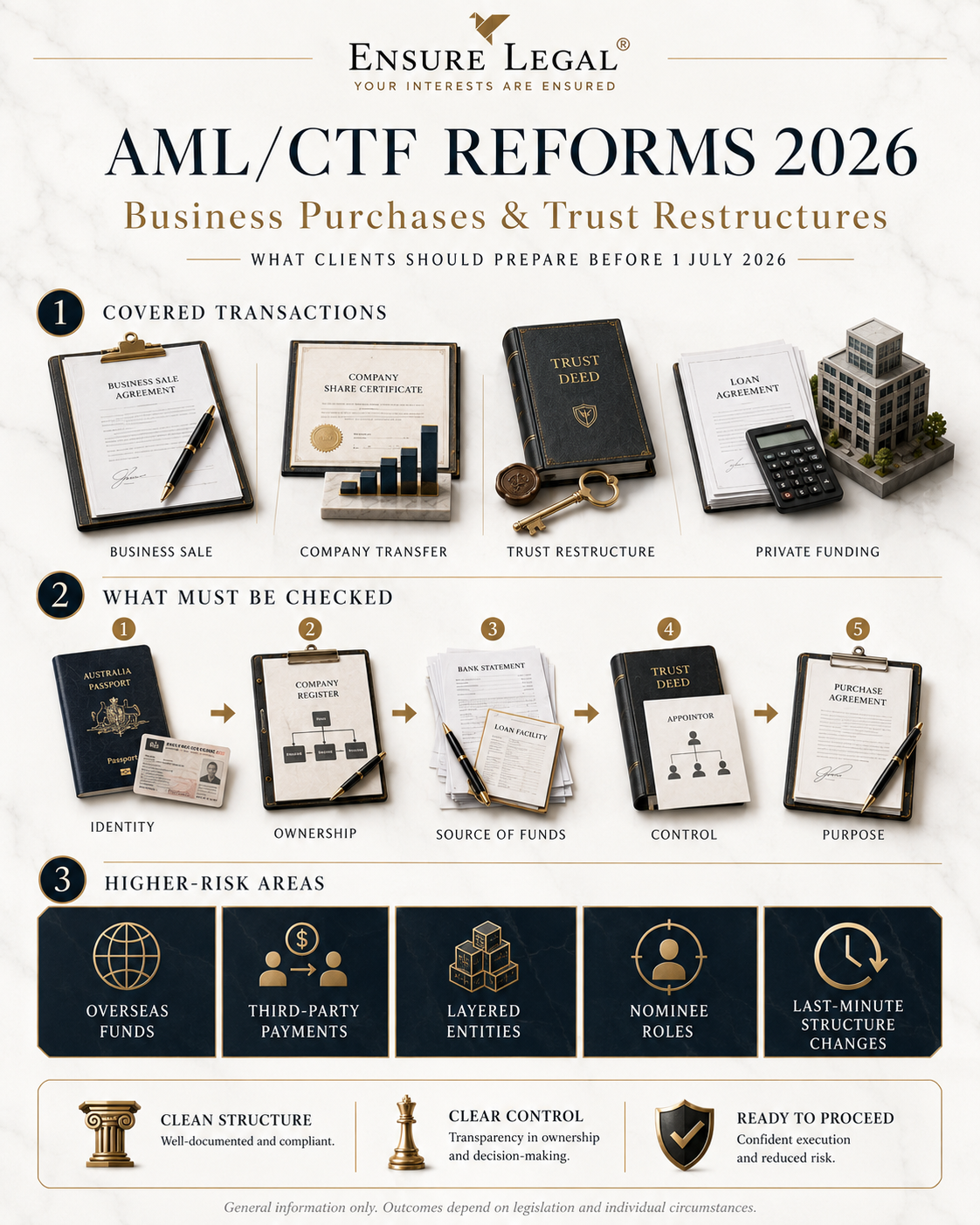
Australia’s AML/CTF reforms are not only a property compliance issue. From 1 July 2026, certain professional services connected with business purchases, company transfers, trust restructures and private investment transactions may fall within the expanded anti-money laundering and counter-terrorism financing regime. For SME owners, family trusts, investors and private companies, the practical message is clear: deal structure, beneficial ownership and funding records must be easier to explain.
This is no longer just a property compliance issue
Much of the public discussion around Australia’s AML/CTF reforms has focused on property buyers and sellers. That is understandable, because real estate transactions often involve high-value assets and complex funding pathways. However, the reforms are broader than property settlement.
The expanded regime also reaches certain professional services connected with companies, trusts, partnerships, joint ventures and other legal arrangements. This means the reforms may become relevant when a client is buying a business, selling shares, restructuring a family trust, changing a corporate trustee, arranging private finance or transferring control of an entity.
For business owners and investors, AML/CTF compliance should now be treated as part of transaction readiness. A deal can be commercially sensible and legally valid, but still become difficult if the ownership, control and funding trail cannot be verified clearly.
Which business transactions may be affected?
The reforms do not automatically regulate every business owner or every private company. The obligations apply to businesses and professionals that provide designated services. However, clients may experience the effect of the reforms because their lawyers, accountants, advisers or transaction service providers may need to collect and verify more information before acting.
In a business transaction context, the following matters may require closer review:
- the purchase or sale of a company;
- the transfer of shares or a controlling interest;
- the sale or acquisition of a business through an asset sale;
- the creation or restructuring of a company, trust, partnership or joint venture;
- the appointment or change of a corporate trustee;
- private debt or equity financing for a company or trust;
- related-party transfers between family members, companies or trusts;
- nominee shareholder or nominee director arrangements; and
- transactions involving overseas funds, overseas shareholders or offshore entities.
The key issue is not whether the client is doing something wrong. The key issue is whether the transaction can be explained with sufficient documentary support.
Business purchases and company transfers may attract closer checks
In a business purchase, the parties often focus on price, lease transfer, employees, stock, plant and equipment, licences and restraint clauses. Under the new AML/CTF environment, another layer becomes important: who is really buying, who controls the purchasing entity, and where the purchase funds are coming from.
This is particularly important where the buyer uses a company, trust or related-party funding arrangement. A purchaser may need to provide company extracts, shareholding information, director details, beneficial ownership records, loan documents, gift records, bank statements or evidence of overseas transfer pathways.
Sellers should also prepare carefully. If the selling entity has changed trustees, issued shares, restructured ownership or received undocumented related-party loans, those issues may create friction during due diligence. Buyers and their advisers may ask more direct questions about control, authority and funding before completion.
Trust restructures are now a documentation risk area
Many Australian families and private business owners use trusts for asset protection, succession planning, tax planning and investment structuring. Trusts can remain useful, but they should not be treated as “set and forget” documents.
A trust restructure may involve changing a trustee, appointor, beneficiary class, unit holder, corporate trustee, asset holding structure or control mechanism. Even where the restructure is lawful, it may raise practical questions under the AML/CTF framework if the documents are old, inconsistent or incomplete.
Clients should check whether their trust deed, variations, trustee appointment documents, appointor provisions, beneficiary clauses and loan accounts are current and internally consistent. If a family trust is involved in a business acquisition, property transfer, company restructuring or private financing arrangement, unclear trust records may delay the transaction.
Company and trust structures must show who controls the deal
One of the practical effects of the AML/CTF reforms is greater attention on beneficial ownership and control. A company name or trust name is not enough. Advisers may need to understand who ultimately owns, controls or benefits from the structure.
For a private company, this may involve reviewing directors, shareholders, ultimate beneficial owners and any person who exercises practical control. For a trust, this may involve reviewing the trustee, appointor, settlor, beneficiaries, guardian or other controlling positions depending on the deed.
Where ownership is layered across multiple entities, the transaction may require a structure chart. This is especially important for family groups, foreign shareholders, investment syndicates, development vehicles and joint ventures.
Private finance and related-party loans need a cleaner paper trail
SME transactions often use private funding. The money may come from retained business profits, family loans, shareholder loans, overseas relatives, property refinance, inheritance, sale proceeds or a combination of sources.
Under the new AML/CTF environment, informal explanations may not be enough. Clients may be asked to produce documents showing the source of funds and, in higher-risk cases, the source of wealth. This may include loan agreements, bank statements, sale contracts, dividend records, business income records, gift letters, inheritance documents or foreign transfer records.
The risk is not limited to large corporate acquisitions. A small business purchase can still become difficult if the buyer cannot explain the funding path or if a third party is paying without a clear legal basis.
Professional services may be captured where advisers help create or restructure entities
The reforms are important because they focus on specific designated services, not merely professional titles. A lawyer, accountant or adviser may be outside the regime for one type of work, but inside the regime for another type of work if the service directly advances a regulated transaction or the creation or restructuring of a company, trust or other legal arrangement.
This distinction matters. General advice may be different from acting on instructions to prepare documents, negotiate a transaction, create a company, establish a trust, restructure an entity, arrange nominee positions or prepare for settlement.
For clients, the practical result is that onboarding and verification may happen earlier in the matter. Advisers may need to understand the structure before they can safely progress documents.
Red flags in SME and private transactions
Business owners should be alert to transaction features that may attract additional questions. These do not automatically mean a transaction is improper, but they may require stronger supporting documents.
- a buyer or seller who cannot clearly explain the commercial reason for the transaction;
- funds coming from a third party who is not clearly connected to the transaction;
- large payments from overseas without a clear source of funds;
- complex company or trust layers with no obvious commercial rationale;
- nominee shareholder, nominee director or informal control arrangements;
- last-minute changes to buyer entity, trustee or funding source;
- related-party loans without written loan agreements;
- trust deeds or company records that do not match the current structure; and
- transactions involving high-risk jurisdictions or sanctioned persons.
The safest approach is to identify these issues before signing, not at settlement or completion.
What documents should business owners prepare?
The documents required will depend on the transaction, the parties and the risk profile. However, business owners, investors and family groups should consider preparing the following before a major transaction:
| Area | Documents to check |
|---|---|
| Company ownership | ASIC records, constitution, share register, director details and shareholder information |
| Trust structure | Trust deed, deed variations, trustee appointment documents, appointor clauses and beneficiary provisions |
| Funding | Bank statements, loan agreements, gift letters, sale contracts, refinance documents and foreign transfer records |
| Control | Structure chart, beneficial ownership records and evidence of who controls each entity |
| Transaction purpose | Heads of agreement, sale contract, finance documents, board approvals and written commercial rationale |
| Related-party dealings | Loan accounts, distribution records, director resolutions and tax/accounting support documents |
These records are not just compliance paperwork. They can affect whether a transaction moves smoothly, whether advisers can act efficiently and whether counterparties have confidence in the deal.
AML/CTF governance is becoming a management issue
For businesses that become regulated under the AML/CTF regime, compliance is not merely an administrative form. AUSTRAC expects newly regulated businesses to have an AML/CTF program, appoint an AML/CTF compliance officer, train staff and be ready to engage with customers and report suspicious matters.
This is especially relevant for businesses that provide professional or transactional services. Directors and senior managers should understand whether the business provides designated services, whether enrolment is required, who is responsible for the AML/CTF program and how the business will manage customer due diligence, record keeping and suspicious matter reporting.
Small businesses should not assume they are exempt simply because they are not a bank or casino. The reforms were designed to extend AML/CTF obligations into sectors that may handle or facilitate high-value transactions.
How this connects with family trust and tax reform planning
The AML/CTF reforms also interact with broader structural review issues. Many clients are already reviewing family trusts, company structures and asset holding arrangements because of tax, succession, asset protection or business growth considerations.
That review should now include documentation quality. A structure may be tax-effective but still difficult to verify. A family trust may be valid but poorly documented. A company may own valuable assets but have outdated share records. A private loan may be genuine but unsupported by written terms.
Before restructuring, clients should obtain legal and tax advice. Moving assets, changing trustees or transferring shares can create tax, duty, control, succession and compliance consequences.
Ensure Legal’s view: clean structure is now part of deal readiness
The AML/CTF reforms signal a broader shift in Australian transactions. For business purchases, trust restructures and company transfers, legal documentation is no longer only about contract enforceability. It is also about whether the transaction can be verified and explained.
Clients should prepare early if they are planning to buy or sell a business, restructure a family trust, change a corporate trustee, transfer shares, introduce private investors or receive overseas funds.
Ensure Legal assists clients with business transactions, commercial law, property law, leasing, trust-related legal issues and private company matters. Early legal review can help identify structural issues before they become transaction delays.
Planning a business purchase, trust restructure or company transfer?
Speak with Ensure Legal before signing, restructuring or settling. We can review the legal structure, authority documents, trust records and transaction risks before the matter becomes urgent.
Frequently asked questions
Do the AML/CTF reforms apply to every business sale?
Not automatically. The reforms apply to businesses and professionals that provide designated services. However, business buyers and sellers may need to provide more information because their advisers may have AML/CTF obligations.
Can a family trust restructure be affected?
Yes, where the work involves the creation or restructuring of a trust or other legal arrangement, or where the trust is involved in a regulated transaction. The exact position depends on the services provided and the facts of the matter.
What is beneficial ownership?
Beneficial ownership refers to the person or persons who ultimately own, benefit from or control an entity or arrangement, even if the legal title is held by a company, trustee or nominee.
What should I prepare before buying a business through a company or trust?
You should prepare identity documents, company records, trust documents, structure charts, funding evidence, loan documents and records showing who controls the buying entity.
Should I review my trust deed before a business transaction?
Yes. If a trust is involved in buying, selling, financing or restructuring assets, the trust deed, trustee powers, appointor provisions and beneficiary clauses should be reviewed before signing transaction documents.
This article provides general information only and does not constitute legal, tax or financial advice. AML/CTF obligations depend on the services provided, the transaction structure and the facts of each matter. You should obtain advice specific to your circumstances.