
Buying Shares in a Company That Owns Property? Landholder Duty May Apply
More investors are using companies and trusts to purchase and hold real estate, commercial property, development sites and other land-based investments.
As these investment structures become more common, transactions increasingly involve:
- the transfer or sale of company shares;
- the introduction of new shareholders;
- shareholder buy-outs;
- changes in ownership percentages;
- corporate restructures; and
- acquisitions of companies that already own property.
A common assumption is that if the property itself is not transferred, no property-related stamp duty should apply.
That is not necessarily the case.
In Queensland, an acquisition of shares in a company that holds substantial Queensland land can potentially trigger landholder duty, even though the registered ownership of the underlying property does not change.
Queensland Revenue Office confirms that although transfers of ordinary company shares are generally not subject to duty, duty may still apply where the corporation has Queensland land-holdings with an unencumbered value of $2 million or more.
What Is Landholder Duty?
Landholder duty is a form of stamp duty that can apply when a person acquires a relevant interest in an entity that owns land.
Rather than looking only at whether the land title itself has been transferred, the legislation can look through the corporate structure and examine the economic interest in the underlying land that has effectively been acquired.
For example, instead of purchasing a commercial building directly, an investor might purchase 50% of the shares in the company that owns the building.
The title to the property stays in the company’s name.
However, the investor has effectively acquired a substantial indirect interest in that property.
This is where landholder duty becomes relevant.
What Is the Queensland Landholder Threshold?
For Queensland landholder duty purposes, a landholder can include a corporation or listed unit trust with Queensland land-holdings having an unencumbered value of $2 million or more.
An important point is that the test is based on unencumbered value.
This generally means the value of the property is considered without deducting liabilities such as a mortgage.
For example:
Property market value: $3,000,000
Mortgage: $2,000,000
Net equity: $1,000,000
For landholder duty purposes, it would generally be incorrect simply to say that the land is worth only $1 million because there is a $2 million mortgage.
The relevant concept is the property’s unencumbered value, not the company’s net equity in the property.
How Much of the Company Must You Acquire?
Meeting the $2 million land threshold does not mean every transfer of shares automatically attracts landholder duty.
The size of the interest acquired is also relevant.
For a Queensland private landholder, such as an unlisted private company, a significant interest is generally 50% or more.
For a public landholder, such as a listed corporation or listed unit trust, the significant interest threshold is generally 90% or more.
This means that one of the most common Queensland scenarios is:
A private company owns at least $2 million of Queensland land, and an investor acquires 50% or more of the company.
However, the analysis can become more complicated where the purchaser already owns shares, acquires shares through multiple transactions, or related persons also hold interests in the entity.
Accordingly, it is not always sufficient to look only at the percentage shown on a single share transfer form.
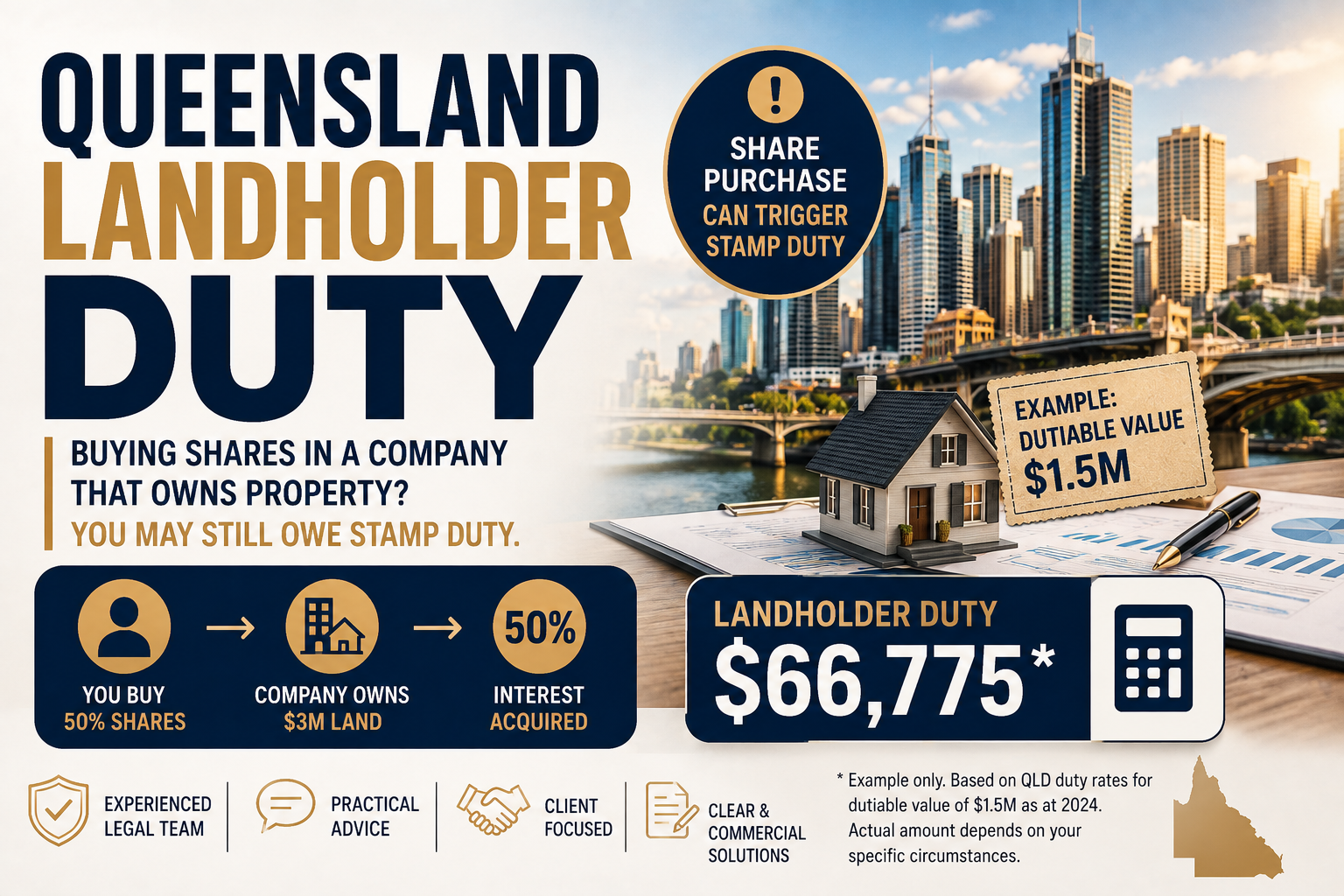
Example: Mr Chan Buys 50% of a Company Holding $3 Million of Queensland Land
Consider the following example.
Mr Chan purchases 50% of the shares in A Pty Ltd.
A Pty Ltd owns Queensland land with an unencumbered value of:
$3,000,000
Because the company’s Queensland land-holdings exceed the $2 million landholder threshold, A Pty Ltd may be a Queensland landholder.
Mr Chan is acquiring 50% of the company.
For a private landholder, 50% is generally the threshold for a significant interest.
On a simplified example where the duty calculation is based on 50% of the $3 million Queensland land value:
$3,000,000 × 50% = $1,500,000
The relevant value attributable to Mr Chan’s acquisition is therefore:
$1,500,000
Queensland’s current general transfer duty rates also apply to landholder duty. For values over $1 million, the current rate is $38,025 plus $5.75 for every $100, or part of $100, above $1 million.
Accordingly:
$38,025 + ($500,000 ÷ $100 × $5.75)
= $38,025 + $28,750
= $66,775
In this simplified example, Mr Chan could therefore face approximately:
$66,775 in Queensland landholder duty
even though he did not directly purchase or transfer the property itself.
This illustrates an important principle for investors:
Buying shares instead of buying the property does not necessarily eliminate stamp duty.
Landholder Thresholds Across Australia
Landholder duty legislation is state and territory based. Each jurisdiction has its own thresholds, acquisition rules, definitions and exemptions.
As a general comparison:
| State / Territory | Indicative Landholding Threshold |
|---|---|
| Victoria | $1,000,000 |
| New South Wales | $2,000,000 |
| Queensland | $2,000,000 |
| Western Australia | $2,000,000 |
| South Australia | No general $1 million threshold; different rules apply depending on land type |
| Tasmania | $500,000 |
| Northern Territory | $500,000 |
| Australian Capital Territory | No general minimum landholding threshold; separate duty thresholds and rates apply |
Victoria’s landholder provisions generally begin where Victorian land holdings are valued at $1 million or more, with a statutory phase-in calculation applying where holdings are between $1 million and $2 million.
NSW generally applies a $2 million landholding threshold. However, acquisition thresholds can vary depending on whether the entity is a private company, public landholder or private unit trust.
Western Australia’s general landholder threshold is also $2 million.
Tasmania applies a $500,000 threshold to companies and unit trust schemes.
The Northern Territory also applies a $500,000 unencumbered land value threshold, with significant interests generally beginning at 50% for unlisted entities and 90% for listed entities.
South Australia’s regime is different. The former $1 million threshold was removed, and the current landholder provisions have particular application to residential and primary production land.
For this reason, a national “threshold table” should only be used as an initial reference point. It should not be used by itself to determine whether a particular transaction is subject to duty.
A $2 Million Company Does Not Necessarily Mean a $2 Million Share Purchase
Another important distinction is that the landholder threshold tests the value of the land held by the entity, rather than simply the value of the shares being purchased.
For example, suppose:
- a company owns $3 million of Queensland land;
- an investor buys 50% of the company; and
- the agreed price for the shares is $800,000.
It would be incorrect to conclude that landholder duty cannot apply merely because the investor paid less than $2 million for the shares.
The relevant landholding test concerns the underlying land held by the entity.
This distinction is particularly important when purchasing companies that have owned property for many years and where the historical accounting value of the property may be substantially below its current market value.
Mortgages Do Not Necessarily Reduce the Landholder Threshold
Investors should also be careful when reviewing a company’s balance sheet.
A company may have:
Land value: $3 million
Bank loan: $2.4 million
Net property equity: $600,000
From a commercial perspective, the company may only have $600,000 of net equity in the property.
However, Queensland’s landholder test is based on the unencumbered value of the Queensland land-holdings.
The existence of substantial bank debt does not therefore necessarily take the company below the $2 million landholder threshold.
Existing Shareholdings and Related Parties Can Matter
Landholder duty becomes more complicated where an investor already owns part of the entity.
For example:
Existing ownership: 40%
Further acquisition: 20%
Ownership after transaction: 60%
It may be dangerous to analyse the transaction merely as “a purchase of 20%”.
Queensland landholder duty rules deal with relevant acquisitions, significant interests and increases in existing interests. Interests held by related persons can also be relevant to the analysis.
This is one reason why investors should obtain advice before signing share sale agreements or restructuring ownership.
Foreign Investors Should Also Consider AFAD
If a foreign person makes a relevant acquisition involving a Queensland private landholder that holds residential land, Additional Foreign Acquirer Duty (AFAD) may also need to be considered.
Queensland’s current AFAD rate is 8%, in addition to ordinary duty, where the statutory requirements are satisfied.
The potential duty exposure can therefore be substantially higher for some foreign investors.
When Should You Check for Landholder Duty?
Landholder duty should be considered early where a proposed transaction involves:
- purchasing shares in a property-owning company;
- selling shares in a company holding commercial property;
- buying into a property development company;
- shareholder buy-outs;
- introducing new investors;
- changing shareholder percentages;
- corporate restructures;
- transferring interests between related entities;
- acquiring control of a property investment entity; or
- restructuring an investment held through a company or trust.
The issue should ideally be considered before the transaction documents are signed, because the amount of duty can materially affect the commercial cost of the transaction.
Share Sale Does Not Automatically Mean “No Stamp Duty”
Landholder duty is an area that can easily be overlooked because the transaction documentation may appear to relate only to shares.
The parties may spend most of their time negotiating:
- the share purchase price;
- shareholder loans;
- warranties and indemnities;
- director resignations;
- liabilities;
- completion accounts; and
- post-completion obligations.
But where the target company holds valuable Australian real estate, the underlying property position can be just as important.
A share transaction that appears relatively simple may carry a significant landholder duty liability.
How Ensure Legal Can Assist
If you are buying, selling or restructuring an entity that owns Queensland property, it is important to consider the duty implications before completing the transaction.
Ensure Legal can assist with matters including:
- Share Sale Agreements
- property-holding company acquisitions
- shareholder buy-outs
- company and investment restructures
- commercial property transactions
- development site transactions
- due diligence
- Queensland landholder duty considerations
- foreign investor property transactions
Early legal review can help identify potential duty issues before they become an unexpected cost at settlement or completion.
Contact Ensure Legal if you are considering acquiring shares or an interest in a company that owns Queensland property.
Disclaimer: This article provides general information only and does not constitute legal, taxation or financial advice. Landholder duty is highly dependent on the particular ownership structure, acquisition history, land values, related-party interests, type of entity, jurisdiction, available exemptions and the circumstances of the transaction. Specific advice should be obtained before entering into a transaction.