
Last reviewed: 14 July 2026
Overseas buyers purchasing property in Brisbane may now encounter more detailed identity, ownership and funding checks at an earlier stage of the transaction.
Australia’s expanded anti-money laundering and counter-terrorism financing framework applies to certain designated services provided by lawyers, conveyancers, real estate professionals, accountants and other professional service providers.
These checks do not prevent legitimate overseas investment. Their practical purpose is to help regulated professionals understand who is involved in a transaction, how the acquisition is structured and where the purchase funds originate.
Why overseas buyers may face additional checks
Cross-border property transactions often involve more parties, documents and financial institutions than a straightforward domestic purchase.
An overseas buyer may be:
- signing documents from another jurisdiction;
- using identification issued outside Australia;
- transferring funds from an overseas bank account;
- purchasing through a company, trust or nominee structure;
- receiving funds from family members or related entities;
- using income or assets accumulated in another country; or
- requiring foreign investment approval before proceeding.
None of these circumstances is automatically problematic. However, they may require a clearer documentary trail and more time for verification.
What information may be requested
The documents required will depend on the buyer, the ownership structure, the funding arrangement and the risk profile of the transaction.
Common requests may include:
- a current passport or other government-issued identification;
- proof of overseas residential address;
- visa or residency information where relevant;
- company incorporation records;
- trust deeds and related trust documents;
- details of directors, shareholders, trustees and beneficial owners;
- bank statements showing the source and movement of purchase funds;
- documents evidencing employment income, business income or investment proceeds;
- sale contracts or settlement statements for assets previously sold;
- gift letters or private loan agreements;
- details of the account from which settlement funds will be remitted; and
- certified translations where documents are not in English.
Further information may be required where the names, entities, account holders or payment arrangements do not align with the information initially provided.
Source of funds for an overseas property purchase
Source of funds concerns the immediate origin of the money being used for the deposit, purchase price and transaction costs.
Examples include:
- personal savings;
- bank finance;
- proceeds from selling another property;
- business distributions;
- investment income;
- inheritance;
- a family gift; or
- a private loan.
A statement showing money in an account may not always be sufficient by itself. The professional involved may also need to understand how the money was accumulated or why it was transferred through particular accounts.
Source of wealth may also be relevant
Source of wealth is broader than source of funds. It concerns how the buyer accumulated their overall financial position.
This may include wealth generated through:
- salary or professional income;
- business ownership;
- investment portfolios;
- property holdings;
- inheritance;
- family wealth; or
- the sale of a business or other substantial asset.
More detailed source-of-wealth enquiries are more likely where the transaction involves a complex ownership structure, a higher-risk jurisdiction, unusual payment arrangements or a substantial mismatch between the transaction and the information provided.
Beneficial ownership and purchasing structures
Where property is acquired through a company, trust or other entity, the legal owner shown on the contract may not be the only person who needs to be identified.
The legal team may need to understand the individuals who ultimately own, control or benefit from the purchasing entity.
Relevant documents may include:
- company extracts and constitutions;
- shareholder registers;
- trust deeds and variations;
- documents identifying trustees, appointors or beneficiaries;
- organisation charts; and
- resolutions or authorities approving the acquisition.
Buyers should provide this information before contract dates become urgent.
AML/CTF checks and FIRB approval are separate
AML/CTF compliance and Australia’s foreign investment rules address different legal issues.
AML/CTF checks focus on matters such as identity, ownership, transaction risk and the origin of funds.
Foreign investment approval concerns whether a foreign person is permitted to acquire the relevant Australian property or interest.
Satisfying one process does not satisfy the other.
Foreign investors will generally need to notify the Australian Taxation Office before acquiring residential land, regardless of value. A contract should therefore be reviewed before signing, particularly where approval may be required.
Can overseas buyers purchase established homes?
From 1 April 2025 to 30 June 2029, foreign investors are generally prohibited from purchasing established dwellings in Australia, subject to limited exceptions.
This does not amount to a complete prohibition on all residential property investment.
Depending on the circumstances, foreign buyers may still be able to acquire:
- new dwellings;
- certain near-new dwellings;
- vacant residential land, generally subject to development conditions;
- property covered by an applicable developer exemption certificate; or
- an established dwelling where a specific exception applies.
The applicable category should be confirmed before a buyer signs a binding contract.
Where the checks fit into the purchase process
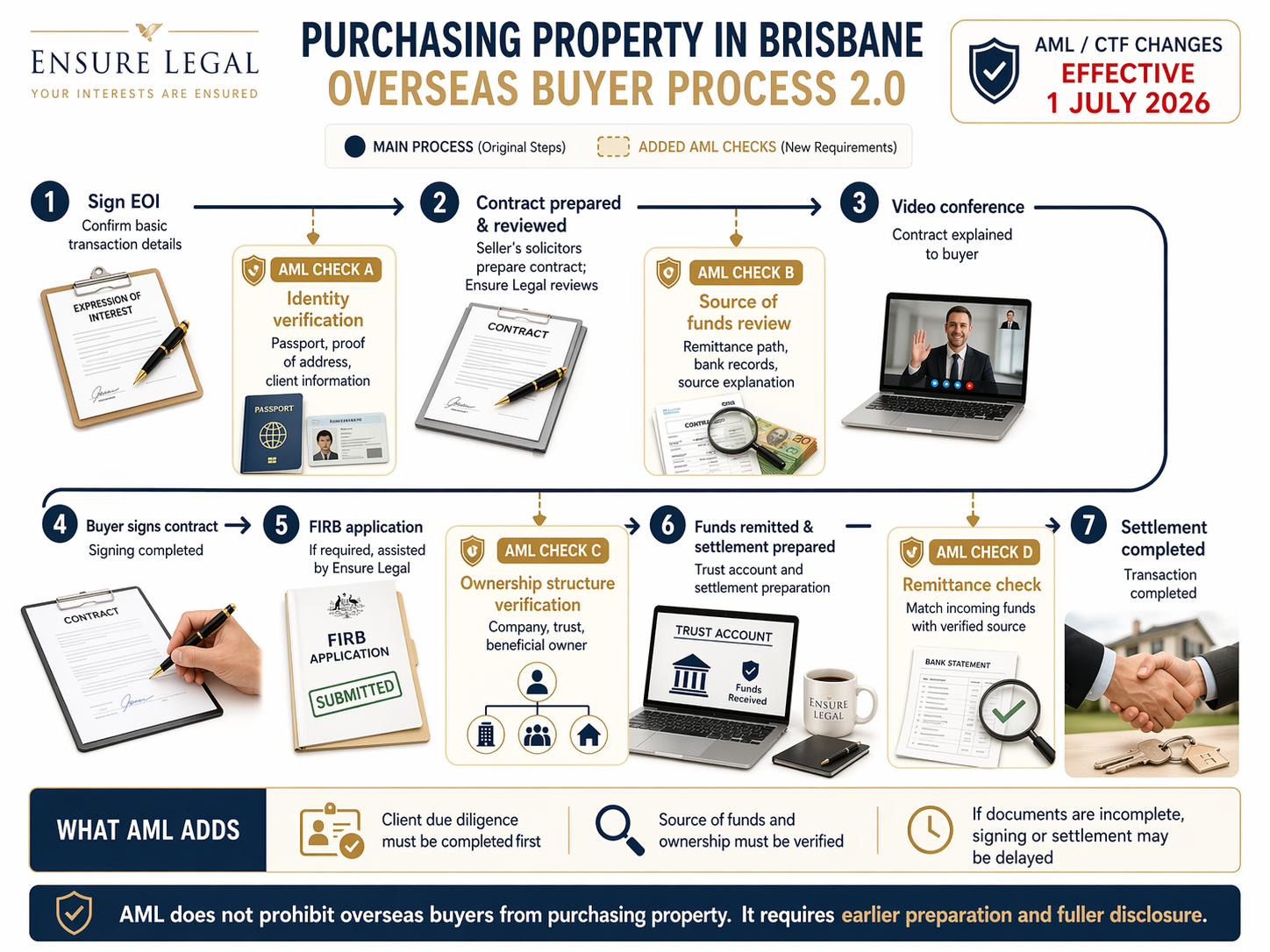
1. Initial enquiry
The lawyer may first identify the proposed buyer, ownership structure, funding source and whether foreign investment approval may be required.
2. Contract review
The contract should be reviewed for title, dates, conditions, risk allocation and any required FIRB or finance condition.
This is also an appropriate stage to identify missing identification, entity or funding documents.
3. Client verification
Identity and authority checks may be completed through approved electronic systems, certified documents or a video conference, depending on the circumstances.
4. FIRB or other regulatory approval
Where approval is required, the contract should adequately protect the buyer while the application is being determined.
5. Funding preparation
The buyer should confirm which account will remit the deposit and settlement funds and whether any third party will contribute money.
6. Settlement
The final money trail should remain consistent with the information and documents previously supplied.
Common causes of delay
Overseas purchases may be delayed where:
- documents are supplied shortly before settlement;
- identification documents have expired;
- names are inconsistent across passports, bank accounts and entity records;
- trust or company documents are incomplete;
- the funds come from an account held by another person or entity;
- the source of a large transfer is unclear;
- a gift and a loan have not been properly distinguished;
- certified translations are unavailable;
- the buyer changes the purchasing entity after signing; or
- FIRB approval has not been addressed in the contract.
Practical preparation checklist
- Seek advice before signing. Confirm the proposed ownership structure and whether FIRB approval may be required.
- Prepare identification documents. Ensure passports, address documents and certifications are current.
- Provide entity documents early. Companies and trusts usually require more than a basic name search.
- Map the funding pathway. Identify the origin account, intermediary accounts and final settlement account.
- Document gifts and private loans. Clarify whether third-party funds are repayable.
- Arrange translations. Allow sufficient time for certified English translations where needed.
- Avoid unexplained last-minute changes. Changes to the buyer, lender or source of funds may require additional review.
How Ensure Legal can assist
Ensure Legal advises overseas buyers on Brisbane and Queensland property transactions, including contract review, conveyancing, foreign investment approval issues and transaction structuring.
Early legal advice can help coordinate the contract timetable with identification, ownership, funding and foreign investment requirements.
Contact Ensure Legal before signing a Queensland property contract.
Disclaimer: This article provides general information only and does not constitute legal advice. AML/CTF and foreign investment requirements depend on the parties, transaction and services involved. Obtain advice about your specific circumstances.