
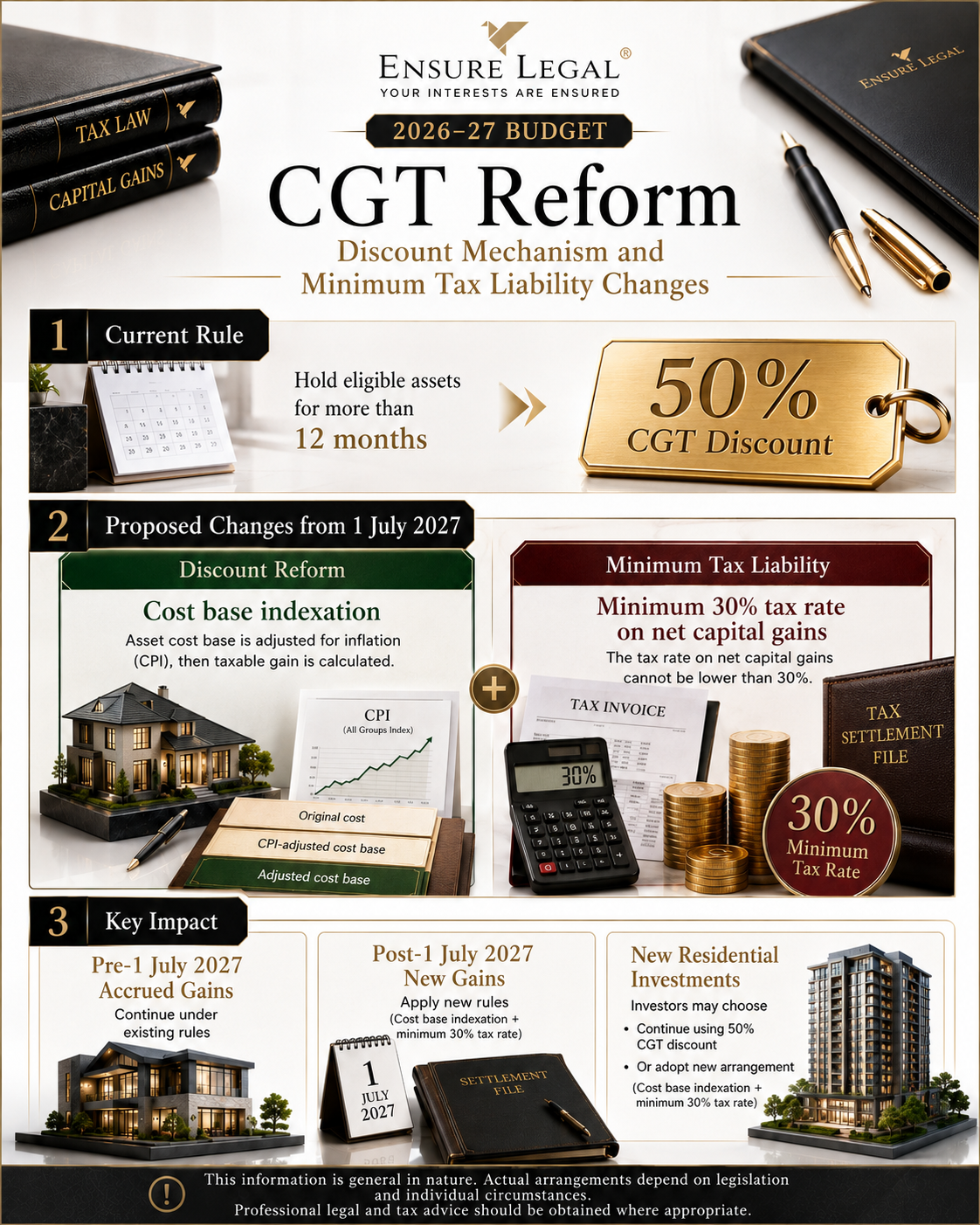
Australia’s 2026 – 27 Federal Budget includes one of the most significant proposed changes to capital gains tax in decades. From 1 July 2027, the Government proposes to replace the current 50% capital gains tax discount for individuals, trusts and partnerships with cost base indexation and a 30% minimum tax rate on capital gains. The reform is part of a broader tax package that also includes changes to negative gearing for residential property investment.
For property investors, family trusts, business owners and high-net-worth families, this is not just a tax issue. It may affect asset holding structures, property sale timing, trust arrangements, succession planning and investment strategy.
This article explains the proposed CGT changes and the legal issues investors should consider before 1 July 2027.
What is the current CGT discount?
Under the current rules, individuals, trusts and partnerships may generally access a 50% CGT discount where an eligible CGT asset has been held for more than 12 months. In practical terms, this means only half of the capital gain is included in taxable income, subject to the taxpayer’s circumstances and applicable tax rules.
This treatment has been a major feature of Australian property and investment planning since 1999. It has influenced how investors hold property, when they sell, and whether they use structures such as family trusts or partnerships.
What is proposed to change from 1 July 2027?
The Budget proposes two key changes.
First, the 50% CGT discount would be replaced with cost base indexation. Instead of automatically reducing the taxable capital gain by 50%, the asset’s cost base would be adjusted for inflation, using the Consumer Price Index. This is intended to tax the “real” capital gain rather than the inflationary component of the gain.
Second, a 30% minimum tax rate would apply to real capital gains accruing from 1 July 2027. The Government says this minimum tax will not affect taxpayers whose capital gains are already taxed at rates of at least 30%, and income support recipients, including pensioners, are expected to be exempt from the minimum tax.
In simple terms, the proposed system moves away from a fixed 50% discount and toward a two-part model: inflation adjustment plus a minimum tax floor.
Will the reform affect gains before 1 July 2027?
The proposed CGT reform is prospective. According to the Budget papers, the 50% CGT discount will continue to apply to gains that accrued before commencement. For assets held before 1 July 2027 but sold after that date, the gain may need to be split between the pre-1 July 2027 component and the post-1 July 2027 component.
This is important for investors who already hold investment properties, shares, business assets or trust-held assets. The legal and tax position may depend on valuation, record-keeping, cost base evidence and how the asset is held.
What about new residential properties?
The Budget gives special treatment to new housing supply. Investors who buy new builds may be able to choose either the 50% CGT discount or the new indexation and minimum tax method when they sell the property.
This distinction may become important when reviewing a proposed property purchase. Investors should understand whether the property is treated as a new build, whether it has previously been sold or occupied, and whether the contract and settlement documents support the intended tax treatment.
Why this matters for property investors
The proposed reform may affect the after-tax return of property investments. A property that looks commercially attractive under the existing 50% discount may produce a different result under cost base indexation and a minimum tax floor.
Investors should review:
The purchase date and expected sale date.
Whether the property is an existing dwelling or a new build.
The likely valuation position as at 1 July 2027.
Whether the asset is held personally, through a trust, partnership or company.
Whether there are loan, trust distribution or succession issues connected with the asset.
Whether the sale strategy should be reviewed before entering into a new contract.
The legal point is this: CGT reform does not only affect the final tax calculation. It may influence how contracts are structured, how assets are held, and how family or business groups plan future transfers.
Why trusts need particular attention
Many Australian families and business owners hold property, shares or business assets through discretionary trusts or family trusts. The proposed CGT changes may interact with trust deeds, beneficiary entitlements, distribution planning and succession arrangements.
A trust review should consider:
Whether the trust deed gives the trustee sufficient flexibility.
Who controls the trust, including the appointor and trustee structure.
Whether the corporate trustee is properly maintained.
How capital gains are distributed or streamed.
Whether beneficiaries are in Australia or overseas.
Whether the trust forms part of an estate planning or asset protection strategy.
Whether the trust holds residential property, business premises, shares or mixed assets.
Trusts are often set up and then left untouched for years. A major tax reform is a practical reason to review whether the structure still works legally, commercially and administratively.
What business owners should consider
CGT reform is not limited to residential property. The Budget materials state that the proposed changes apply broadly to CGT assets, including property and shares, held by individuals, partnerships and trusts for at least 12 months.
Business owners should therefore consider whether the reform could affect:
Sale of business assets.
Sale of shares or units.
Restructuring of business entities.
Transfer of commercial property.
Family succession or buy-out arrangements.
Trust-held business assets.
The Budget papers also state that the current small business CGT concessions will continue unchanged. However, business owners should not assume that their existing structure automatically qualifies for those concessions. Eligibility can depend on technical rules, asset use, turnover, net asset value, ownership and timing.
Legal documents investors should review
Before 1 July 2027, investors and business owners should consider reviewing the following documents:
Property purchase contracts.
Trust deeds.
Company constitutions.
Shareholder or unitholder agreements.
Loan agreements.
Partnership agreements.
Commercial lease documents.
Estate planning documents.
Asset protection arrangements.
Valuation records and cost base evidence.
The goal is not to rush into a transaction. The goal is to understand whether the current legal structure still supports the owner’s investment, tax and succession objectives.
A practical example
A property investor who bought an investment property before 1 July 2027 and sells it after that date may need to distinguish between gains accrued before and after the reform date. The pre-commencement gain may continue to receive the existing treatment, while the post-commencement gain may be calculated under the proposed new rules. The Budget papers indicate that taxpayers may need a valuation or may use a specified apportionment method supported by ATO tools.
That means record-keeping will become more important. Investors should keep purchase contracts, settlement statements, renovation records, valuation evidence, loan documents and ownership records.
Key takeaway
The proposed CGT reform is not simply a tax headline. It may change how investors assess property returns, how trusts are used, how business assets are transferred and how families plan long-term wealth succession.
For investors, the most important step is not to panic. The proposed reforms are scheduled to apply from 1 July 2027, and many details may still depend on legislation, ATO guidance and individual circumstances.
However, property investors, trustees and business owners should use the lead time to review their legal structures, contracts and asset-holding arrangements.
How Ensure Legal can assist
Ensure Legal can assist with the legal aspects of property investment, commercial transactions, trust-related documentation and contract review. Where tax advice is required, we recommend working together with a qualified tax adviser or accountant so that the legal structure and tax strategy are properly aligned.
This article is general information only and does not constitute legal, tax or financial advice. You should obtain advice tailored to your circumstances before making any investment, restructuring or sale decision.