
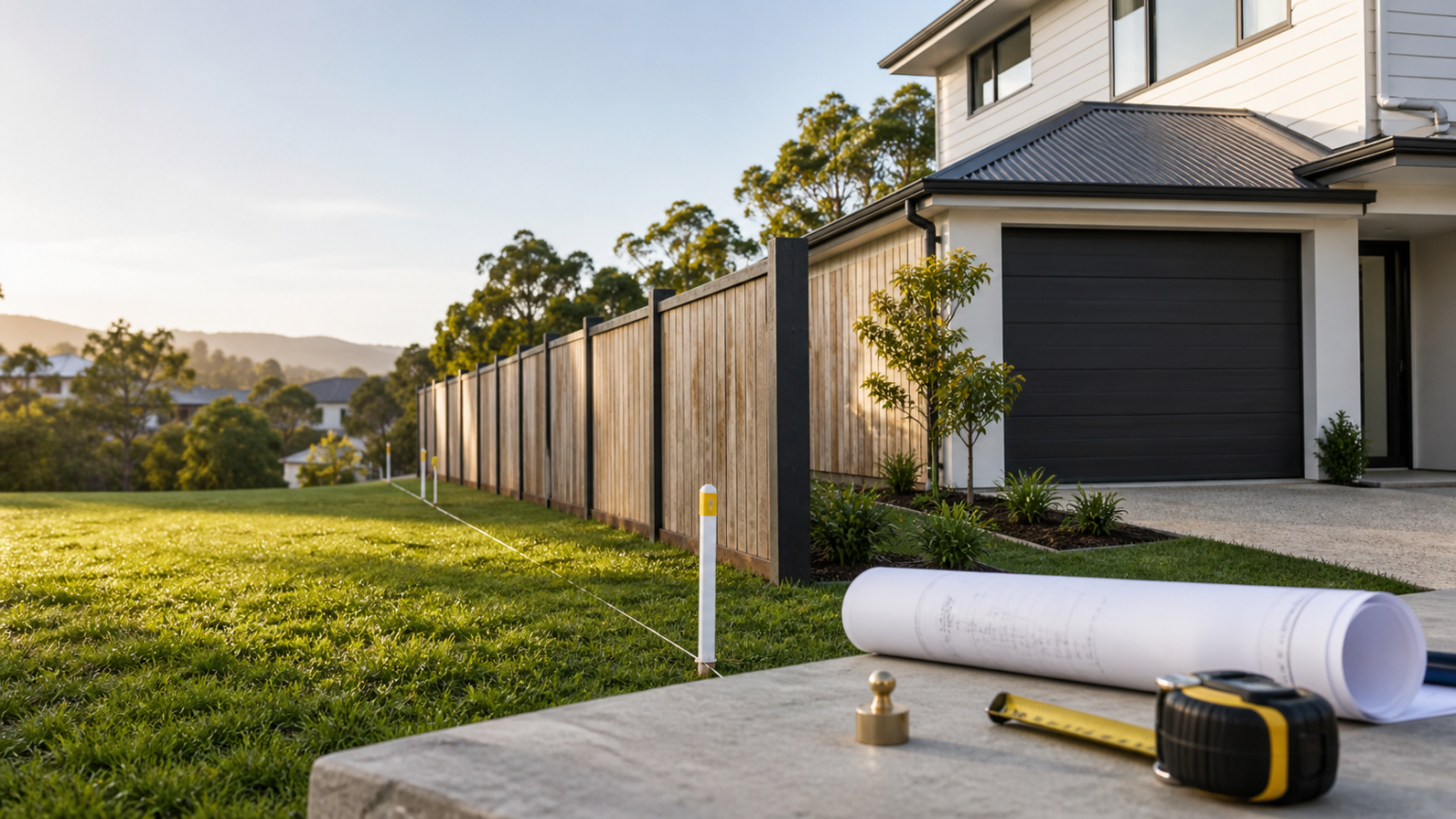
Boundary encroachment Queensland issues can affect what a buyer is actually acquiring, whether existing structures can remain as they are, and what legal or surveying work may be required before settlement.
Quick answer: a fence does not necessarily mark the legal boundary. If a garage, deck, roof overhang, retaining wall or other structure sits close to a boundary, buyers should consider a registered cadastral surveyor’s identification survey and obtain legal advice before signing.
Boundary Encroachment Queensland: Key Takeaways for Buyers
- A title search and an identification survey answer different questions.
- Building encroachments can include walls, overhangs and structures extending into or under neighbouring land.
- Retaining walls are not automatically treated as dividing fences or shared 50/50 expenses.
- If boundary position matters to the purchase, investigate it and seek advice before signing.
The Fence You See Is Not Necessarily the Legal Boundary
When inspecting a property, most buyers naturally assume that the fence marks the edge of the land they are buying.
That assumption can sometimes be wrong.
A fence may have been erected slightly inside one property, across the legal boundary, or simply in a location that previous owners accepted for many years.
The same issue can arise with:
- garages;
- carports;
- decks;
- balconies;
- roof eaves;
- retaining walls;
- sheds; and
- other permanent structures close to a boundary.
In Queensland, property boundaries are determined through the cadastral surveying system. The Queensland Government recommends engaging a registered cadastral surveyor to carry out an identification survey where it is necessary to determine whether a fence is actually positioned on the common boundary.
For a buyer, this means there are really two different questions:
What appears to be part of the property?
and
What legally falls within the property boundary?
They are not always the same.
What Is a Boundary Encroachment?
Under Queensland’s Property Law Act 2023, an encroachment can occur where a substantial permanent building or part of that building extends onto another person’s land.
The legislation expressly includes:
- a building extending onto neighbouring land;
- an overhang extending across the boundary;
- a structure intruding onto or into the neighbouring soil; and
- an intrusion underneath neighbouring land.
This means an encroachment does not necessarily involve an entire room or garage sitting on the wrong property.
It could involve only part of a structure.
For example:
A garage may be constructed mostly inside the property, but one wall extends 20 centimetres over the legal boundary.
Or:
A house may sit entirely within its own lot, while the roof eaves extend over the neighbouring land.
Both situations may require further investigation.
Example: The Garage That Crosses the Boundary
Consider a buyer purchasing a house in Brisbane.
There is a detached garage beside the boundary fence. The garage has existed for many years and appears to form part of the property.
The buyer assumes:
Fence = boundary.
An identification survey later shows something different.
The legal boundary actually runs through part of the garage, meaning the structure extends into the neighbouring property.
That creates questions the buyer should ideally understand before settlement:
- How much of the garage encroaches?
- How long has the structure been there?
- Is there an easement or other registered arrangement?
- Does the neighbour know about the encroachment?
- Has there been a previous agreement between the owners?
- Could the neighbour require the issue to be addressed?
- Does the buyer still want to proceed on the same terms?
A standard visual inspection of the property may never reveal this issue.
How Do You Know Where the Legal Boundary Is?
Queensland’s cadastral surveying system determines property boundaries.
The Queensland Government guidance states that boundaries are defined using survey evidence and survey marks, rather than simply relying on GPS coordinates, kerbs, fences or assumptions based on what can be seen on the ground.
Only appropriately registered cadastral surveyors can undertake cadastral surveys in Queensland.
Where a buyer needs to know whether an existing fence or structure follows the legal boundary, an identification survey can be particularly useful.
A cadastral surveyor can investigate the relevant survey evidence and identify the location of the boundary relative to physical improvements on the property. Queensland’s surveying standards also require relevant encroachments identified during a cadastral survey to be recorded, with substantial encroachments brought to the attention of affected owners.
Does a Title Search Show an Encroachment?
A title search remains an important part of conveyancing due diligence, but it performs a different function from an identification survey.
Title and registered-plan searches can identify matters such as the legal lot description and registered interests affecting the land.
Survey plans are also available through Titles Queensland and provide important cadastral information.
However, determining whether the garage, fence, deck or retaining wall you physically see sits on the legal boundary may require a cadastral surveyor to compare the relevant survey evidence with the actual property.
In practical terms:
| Check | What it helps establish |
|---|---|
| Title Search | Ownership and registered interests |
| Registered Survey Plan | Cadastral parcel information |
| Identification Survey | Where the boundary sits relative to existing structures |
| Building / Council Searches | Approval and certification history where relevant |
These searches complement each other.
When Should a Buyer Consider an Identification Survey?
An identification survey may be worth considering where there are visible signs that boundary location could matter.
Examples include:
1. A building sits very close to the fence
A garage, extension or carport positioned directly beside the fence deserves closer attention where the clearance appears minimal.
2. The fence line looks unusual
A fence may suddenly change direction, contain an unexplained offset or appear inconsistent with neighbouring lots.
3. A retaining wall sits along the boundary
The location of a retaining wall can become important when determining each property’s position and understanding any existing neighbour issue.
Queensland Government guidance specifically recommends a cadastral surveyor where owners need to determine the position of a retaining wall relative to the boundary.
4. A deck, balcony or roof projects toward neighbouring land
Remember that an encroachment under the Property Law Act can include an overhang.
5. The property is being purchased for redevelopment
Even a relatively small boundary discrepancy can become commercially important when a buyer intends to demolish, extend, subdivide or redevelop the property.
6. The seller or agent mentions a neighbour arrangement
Statements such as:
“The neighbour has always been fine with it.”
or
“That fence has been there for 30 years.”
may be useful background information, but they are also reasons to investigate the legal position carefully.
A Fence Is a Separate Issue from a Building Encroachment
A boundary fence dispute and a building encroachment are related concepts, but they are governed by different legal rules.
Queensland’s Neighbourhood Disputes (Dividing Fences and Trees) Act 2011 deals with dividing fences between adjoining owners.
Where a dividing fence sits on the common boundary, the legislation recognises the general position that it is owned equally by the adjoining owners.
However, QCAT explains that a fence located entirely on one owner’s land belongs to that owner, even where the neighbour contributed towards its construction.
Therefore, seeing a fence between two properties does not itself establish where the legal boundary lies.
Where the position of the common boundary is disputed for fencing purposes, Queensland legislation provides a process involving cadastral surveyors to determine that boundary.
What About Retaining Walls?
Retaining walls deserve separate consideration.
A retaining wall is not treated as a dividing fence under Queensland’s dividing-fence legislation. QCAT specifically notes that retaining walls are excluded because they will often benefit one property more than the other, making a simple equal-contribution approach unsuitable.
This means buyers should avoid assuming:
“It is on the boundary, so both neighbours automatically pay 50%.”
Where a retaining wall is involved, questions can include:
- where the wall sits relative to the boundary;
- which property it supports;
- who constructed it;
- who benefits from it;
- its physical condition; and
- whether any agreement or dispute already exists.
Queensland Government guidance recommends obtaining both surveying and legal advice where retaining-wall boundary issues cannot readily be resolved.
What Can Happen When a Building Encroaches?
Queensland’s Property Law Act gives the court significant flexibility when dealing with building encroachments.
Both the owner of the land from which the encroachment extends and the owner whose land is affected can apply to the court for relief.
Depending on the circumstances, the court may make orders including:
- requiring land to be transferred or leased;
- granting an easement or another interest;
- requiring a survey plan to be prepared;
- ordering compensation;
- requiring the structure to be modified; or
- requiring the encroachment to be removed.
The court can consider matters including the circumstances in which the encroachment arose, its nature and extent, the value and situation of the affected land, planning considerations and the potential loss suffered by either owner.
Accordingly, there is no single outcome that applies to every encroachment.
A 50-millimetre roof overhang and half a garage constructed over the boundary present very different circumstances.
“It Has Been There for 20 Years” Does Not Automatically Resolve the Problem
The age of a structure can be relevant to the overall factual history, but buyers should be careful about assuming that a longstanding fence or building automatically changes the legal boundary.
Queensland’s Property Law Act expressly states that interests in land under the Land Title Act 1994 or Land Act 1994 cannot be created simply through prescription or the doctrine of lost modern grant.
The Land Title Act also contains specific restrictions concerning adverse-possession applications arising from encroachments.
Boundary and possession issues can therefore become legally technical. Historical occupation alone should not be treated as proof that ownership has changed.
What Should a Buyer Check Before Signing?
Where a possible boundary issue exists, a practical due-diligence approach may include:
📑 1. Review the Title and Registered Plan
Understand exactly which lot is being purchased and review registered interests such as easements where relevant.
📐 2. Consider an Identification Survey
Where the physical boundary matters, a registered cadastral surveyor can determine the boundary and identify its relationship with fences and structures.
🏠 3. Look Closely at Structures Near the Boundary
Particular attention may be warranted for:
- garages;
- carports;
- extensions;
- decks;
- balconies;
- roof overhangs;
- sheds; and
- retaining walls.
📂 4. Check Relevant Easement Documents
A structure or access arrangement that appears unusual may relate to an existing easement or other registered interest.
Queensland Government guidance notes that easement documents and registered survey plans can be obtained when investigating these issues.
🏗️ 5. Consider Building Approval Records
A boundary survey and building approval search answer different questions.
A survey may establish where the structure is located.
Building and Council records may help investigate what was approved. Our guide to buying a property with unapproved renovations in Queensland explains why approval and certification records may require separate due diligence.
For a structure close to the boundary, both enquiries can be relevant.
⚖️ 6. Ask Your Solicitor Before Signing
Where an apparent encroachment or boundary uncertainty is identified before signing, a solicitor can advise on appropriate further enquiries and whether contractual protection should be considered.
Should a Buyer Add a Special Condition?
Potentially.
If boundary location is important to the purchase, buyers should raise the issue with their solicitor before signing.
Depending on the circumstances, possible approaches may include:
- obtaining the identification survey before making the contract unconditional;
- requesting existing survey material from the seller;
- seeking information about previous neighbour agreements;
- investigating registered easements;
- obtaining legal advice about an identified encroachment; or
- negotiating an appropriately drafted due-diligence or survey condition.
The correct approach depends on the property and the issue identified.
As explained in our guide to Queensland property contracts, a standard Building & Pest clause should not automatically be assumed to protect a buyer against every survey or boundary problem because a physical building inspection and a cadastral boundary investigation serve different purposes.
What If the Encroachment Is Discovered After Signing?
Timing matters.
If a buyer discovers a possible encroachment after entering into the contract, the solicitor may need to review:
- the contract;
- any special conditions;
- the title and registered plan;
- survey results;
- easements;
- seller representations;
- correspondence relating to the boundary; and
- the stage the transaction has reached.
The existence of an encroachment does not automatically produce the same contractual remedy in every transaction.
The legal position will depend on the contract and the particular circumstances.
That is another reason why an obvious boundary concern is best investigated as early as possible.
Surveyor or Solicitor: Who Does What?
These professionals perform different roles.
📐 Registered Cadastral Surveyor
The surveyor can establish the cadastral boundary and determine the physical relationship between that boundary and existing improvements.
Only appropriately registered cadastral surveyors can perform cadastral boundary surveys in Queensland.
⚖️ Property Solicitor
The solicitor can assist with:
- reviewing the contract;
- reviewing title and registered interests;
- considering easement documents;
- interpreting the legal significance of a survey result;
- advising on special conditions;
- reviewing existing agreements;
- advising on an identified encroachment; and
- assessing contractual options before settlement.
The surveyor identifies where the boundary is.
The solicitor assists with what that boundary issue means for the transaction.
Boundary Encroachment Queensland: The Key Point for Buyers
A property inspection tells you what you can see.
A title search tells you important legal information about the land.
But where the exact position of a fence, garage, deck or other structure matters, a cadastral survey may be required to establish the physical boundary accurately. Queensland Government guidance specifically recommends an identification survey to determine whether a fence follows the common boundary.
For buyers, the practical lesson is simple:
Do not assume the fence is the legal boundary.
If something about the property boundary looks unusual, investigate it before signing rather than discovering the issue after settlement.
Buying a Property with a Possible Boundary Issue?
When a boundary encroachment Queensland concern arises, Ensure Legal 安信法律 assists Queensland property buyers and sellers with contract review, title searches, easements, property due diligence, special conditions and legal issues identified before settlement.
Where a fence, garage, extension, deck or other structure appears close to the boundary, we can assist with the legal side of the transaction and work alongside a registered cadastral surveyor where a boundary survey is required.
Checking before signing gives buyers the best opportunity to understand exactly what land—and what potential boundary issue—they are purchasing.
Authoritative Queensland Sources
- Property Law Act 2023 (Queensland Legislation)
- Survey marks and property boundaries (Business Queensland)
- Dividing fence disputes (QCAT)
Sources and legislation checked on 31 August 2026.
Disclaimer: This article provides general information only and does not constitute legal, surveying, building or planning advice. Boundary location, encroachment rights and contractual remedies depend on the individual property, survey evidence, registered interests, contract terms and surrounding circumstances. Obtain professional advice relevant to your transaction before signing a contract.