
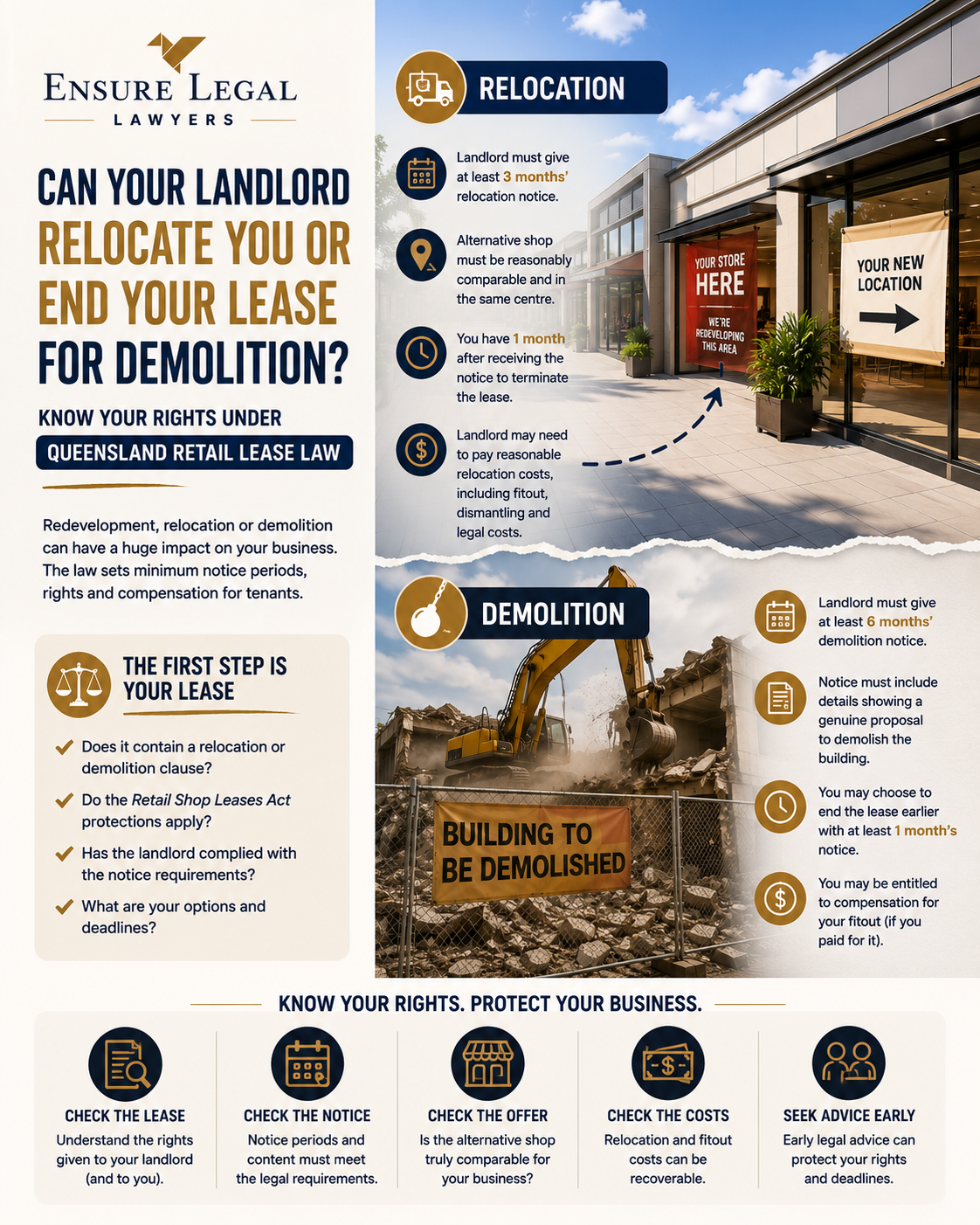
Your Landlord Says the Centre Is Being Redeveloped — Do You Have to Move?
Imagine you operate a café, salon or retail store in Queensland.
You have spent significant money fitting out the premises, built up a regular customer base and still have several years left on your lease.
Then the landlord tells you:
“The centre is being redeveloped. We need you to move to another tenancy.”
Does the landlord have the right to relocate you?
Can you refuse?
Who pays for moving the fitout?
And what happens if the landlord wants to terminate the lease completely because the building is going to be demolished?
For leases covered by the Retail Shop Leases Act 1994 (Qld), there are specific statutory protections dealing with relocation and demolition.
However, there is an important starting point:
The Act does not automatically give every landlord a right to relocate a tenant or terminate a lease for demolition. The lease itself must first be reviewed to determine whether it contains the relevant right.
If it does, the statutory minimum requirements may then significantly affect how that right can be exercised.
First: Is Your Lease a Retail Shop Lease?
The rules discussed in this article relate principally to leases governed by the Retail Shop Leases Act 1994 (Qld).
Whether a lease qualifies depends on the premises and the business conducted there. A retail shop lease commonly involves premises under 1,000 square metres used for a prescribed retail business, or certain premises located within a retail shopping centre. There are statutory exclusions, so the lease title alone does not determine whether the Act applies.
This distinction matters.
A café in a shopping centre may have statutory retail lease protections that do not apply in exactly the same way to a warehouse, office or other non-retail commercial tenancy.
For a non-retail commercial lease, the wording of the lease becomes particularly important when dealing with redevelopment, relocation or early termination.
Relocation: The Lease Must Contain a Relocation Right
Section 46C of the Retail Shop Leases Act applies where a retail shop lease provides for relocation of the tenant’s business during the term.
In that situation, sections 46D to 46G are effectively incorporated into the lease.
This is an important distinction.
A landlord cannot simply rely on the fact that redevelopment would be commercially convenient. The first question for the solicitor is:
What does the signed lease actually allow the landlord to do?
If there is a valid relocation clause, the next question is whether the landlord has complied with the statutory process.
The Landlord Generally Must Give at Least 3 Months’ Notice
If the landlord exercises a relocation provision, the tenant must receive a written relocation notice.
The notice must state:
- sufficient details of the proposed refurbishment, redevelopment or extension;
- enough information to demonstrate a genuine proposal;
- that the work is intended to occur within a reasonably practicable time after relocation;
- that the work cannot practicably be undertaken without vacant possession of the tenant’s existing shop;
- details of a reasonably comparable alternative retail shop; and
- the date by which the tenant must vacate.
Importantly, the relocation notice must generally be given at least 3 months before the relocation date.
So a simple email stating:
“We need you in another tenancy next month because we are renovating.”
may not satisfy the statutory requirements.
The actual lease, formal notice and proposed redevelopment should be reviewed together.
The Replacement Shop Must Be Reasonably Comparable
The landlord cannot simply nominate any available space.
The relocation notice must identify a reasonably comparable alternative retail shop.
If the existing premises are located within a retail shopping centre, the alternative premises specified in the notice must also be within the same shopping centre.
What is “reasonably comparable” will depend on the circumstances.
For a retail tenant, relevant commercial considerations may include:
- floor area;
- configuration;
- frontage;
- visibility;
- pedestrian traffic;
- proximity to major tenants;
- access;
- services;
- permitted use; and
- suitability for the tenant’s existing fitout and business.
A tenancy may technically have a similar floor area but perform very differently if it moves from a prominent ground-floor location to a less visible part of a centre.
This makes the proposed alternative premises an important commercial as well as legal consideration.
The Tenant Has a 1-Month Decision Window
One of the most important deadlines appears after the relocation notice is received.
A tenant may give the landlord written notice terminating the lease within 1 month after receiving the relocation notice.
If the tenant exercises that right, the lease terminates:
- on a date agreed between landlord and tenant; or
- if no date is agreed, 3 months after the relocation notice was given.
But if the tenant does not provide a termination notice within the statutory period, the Act provides that the tenant is taken to have accepted the landlord’s offer of the alternative premises, subject to the applicable statutory arrangements.
This makes the first month particularly important.
A tenant receiving a relocation notice should avoid putting it aside while negotiating informally with centre management.
The notice can start a statutory decision period.
What Happens to the Lease if the Tenant Relocates?
Unless landlord and tenant agree otherwise, the new lease is generally taken to continue on the same terms and conditions as the existing lease.
The remaining lease term also remains the same.
For example:
Existing lease remaining: 3 years and 4 months
Tenant relocates: the new lease generally continues for that remaining period rather than automatically restarting for another full term.
Rent for the replacement shop is based on the rent under the existing lease, adjusted to reflect differences in the commercial value of the two premises.
The parties remain free to negotiate different arrangements.
This can create an opportunity to negotiate matters such as:
- revised rent;
- fitout arrangements;
- rent-free relocation periods;
- new incentives;
- signage;
- trading interruption;
- a longer lease term; or
- other commercial concessions.
The statutory position is therefore often the starting point, rather than necessarily the final commercial deal.
Who Pays the Cost of Relocation?
This is one of the most valuable statutory protections for retail tenants.
Under section 46G, the tenant is entitled to payment by the landlord of the tenant’s reasonable relocation costs.
The legislation expressly includes costs relating to:
- dismantling and reinstalling fixtures and fittings;
- modifying or replacing fixtures and fittings to the standard existing immediately before relocation; and
- legal costs.
For example, a café relocation might involve:
- removing counters;
- dismantling cabinetry;
- moving equipment;
- reconnecting services;
- adjusting the replacement tenancy;
- reinstalling signage;
- modifying fixtures to fit the new premises; and
- obtaining legal advice regarding the relocation documents.
These costs can become substantial.
Tenants should therefore keep clear quotations, invoices and records rather than relying on informal discussions about what the landlord will reimburse.
If the landlord and tenant cannot agree on the amount, the legislation provides for the issue to be determined through the applicable dispute resolution process.
Example: A Café Is Asked to Move Across the Shopping Centre
Consider a café operating from a prominent tenancy near the main entrance of a Queensland shopping centre.
The lease still has four years remaining.
The landlord proposes redevelopment of that part of the centre and issues a relocation notice offering another shop at the opposite end of the centre.
The tenant should not analyse the issue only as:
“Is the new shop roughly the same size?”
The tenant may need to consider:
- Does the lease contain a relocation clause?
- Does the notice describe a genuine redevelopment proposal?
- Has at least 3 months’ notice been provided?
- Is the alternative tenancy reasonably comparable?
- Will customer traffic change?
- What rent should apply to the new premises?
- How much will relocation cost?
- Which costs must the landlord pay?
- Does the tenant prefer to terminate instead?
- Is the 1-month termination deadline approaching?
The commercial and legal analysis should occur together.
What About Demolition Clauses?
Demolition is treated differently from relocation.
Sections 46H to 46K apply where a retail shop lease contains a provision allowing the landlord to terminate because the building containing the shop is to be demolished and vacant possession is required.
Again, the important starting point is:
The legislation does not create an automatic demolition right where the lease itself contains no such right.
The lease must first be reviewed.
A Demolition Notice Generally Requires at Least 6 Months
Where the demolition provisions apply, the landlord must give the tenant written notice.
The notice must contain sufficient details to show there is a genuine proposal to demolish the building within a reasonably practicable time after termination.
It must also state the termination date.
The landlord must generally give the notice at least 6 months before the termination date.
This genuine-proposal requirement is important.
A demolition clause is not simply intended to operate as a convenient method of ending an unwanted retail tenancy without an actual demolition proposal.
Can the Tenant Leave Earlier?
Yes.
After receiving a valid landlord demolition termination notice, the tenant may elect to terminate the lease earlier.
The tenant must give the landlord written notice at least 1 month before the tenant’s proposed earlier termination date.
This may be commercially useful.
For example, a business may secure alternative premises three months before the landlord’s demolition date and prefer to relocate immediately rather than continue trading from premises that are approaching closure.
The statutory mechanism can give the tenant flexibility to leave earlier.
Is Compensation Payable for Demolition?
Potentially—and the rules are more nuanced than simply saying “the landlord must compensate the tenant”.
Section 46K provides for reasonable compensation in particular circumstances.
The landlord may be liable for loss or damage suffered because of early termination if the proposed demolition is ultimately not carried out, or is not carried out within a reasonably practicable time after termination.
However, that particular compensation exposure does not apply where the landlord proves that, when the demolition notice was given, there was genuinely a proposal to demolish the building within a reasonably practicable period.
Separately, the legislation provides for reasonable compensation relating to the tenant’s fitout, to the extent that the fitout was not provided by the landlord, whether or not demolition ultimately occurs.
“Fit out” for this purpose includes matters such as finishes, fixtures, fittings, equipment and services.
The actual compensation calculation can therefore require detailed consideration of:
- who paid for the fitout;
- its existing value;
- the work undertaken;
- the terms of the lease;
- the circumstances surrounding termination; and
- any other applicable statutory rights.
Relocation and Demolition Are Not the Same Thing
Although leases often group redevelopment, relocation and demolition provisions together, the statutory rights are different.
| Issue | Relocation | Demolition |
|---|---|---|
| Lease must provide relevant right? | Yes | Yes |
| Main landlord notice period | At least 3 months | At least 6 months |
| Tenant response right | May terminate within 1 month after relocation notice | May terminate earlier with at least 1 month’s notice |
| Alternative premises | Reasonably comparable premises required | Not necessarily applicable |
| Same shopping centre | Required if existing shop is in that centre | Not applicable in the same way |
| Relocation costs | Reasonable relocation costs payable | Different compensation regime |
| Fitout | Relocation/reinstallation costs relevant | Statutory fitout compensation may apply |
The distinction matters because a landlord describing something as a “redevelopment” does not necessarily tell you which contractual or statutory mechanism is actually being exercised.
Do Not Confuse Redevelopment With Ordinary Construction Disturbance
There is another scenario that should be distinguished.
Sometimes the landlord is carrying out substantial construction work around the tenant but is not asking the tenant to relocate or terminate the lease.
The Retail Shop Leases Act contains separate protections dealing with disruption to a tenant’s business, including circumstances where lessor works materially affect access, trading or customer flow.
The Queensland Small Business Commissioner notes that compensation issues may arise where landlord works cause significant disruption, although the application of those provisions depends on the particular facts and notices provided.
This means a tenant experiencing six months of construction outside the shop may have a different legal issue from a tenant who receives a formal relocation notice.
The notice and the lease should be reviewed carefully before determining which statutory rights apply.
What Should a Tenant Do After Receiving a Relocation Notice?
A practical approach is to immediately check:
1. The Lease
Confirm whether the landlord actually has a contractual relocation right.
2. The Notice
Check whether it satisfies the requirements of the Retail Shop Leases Act.
3. The Deadline
Record the 1-month tenant termination period immediately.
4. The Alternative Premises
Inspect the proposed tenancy and assess whether it is genuinely comparable.
5. Rent
Consider whether commercial-value differences justify an adjustment.
6. Fitout and Moving Costs
Prepare a detailed estimate of relocation costs.
7. Business Impact
Consider customer access, visibility, signage, trading disruption and downtime.
8. Negotiation Opportunities
The statutory minimum does not prevent the parties from negotiating a different commercial arrangement.
What Should a Landlord Do Before Exercising These Clauses?
Landlords should also treat relocation and demolition clauses carefully.
Before issuing a notice, consider:
- whether the lease actually creates the relevant right;
- whether the Retail Shop Leases Act applies;
- whether the redevelopment or demolition proposal is sufficiently developed and genuine;
- whether the required statutory notice period can be satisfied;
- whether a proposed alternative tenancy is reasonably comparable;
- likely relocation costs;
- fitout compensation exposure;
- documentation supporting the proposed redevelopment; and
- the commercial consequences of a dispute.
An incorrectly exercised clause can create unnecessary delay at exactly the time a landlord is trying to commence a redevelopment.
What Happens if the Parties Cannot Agree?
Queensland has a statutory dispute resolution framework for retail tenancy disputes.
The Queensland Small Business Commissioner provides mediation services for retail lease disputes, with unresolved matters potentially proceeding to QCAT where the tribunal has jurisdiction.
However, commercial negotiation often occurs before formal proceedings.
For example, the parties might agree that:
- the tenant relocates earlier;
- the landlord provides a larger contribution;
- rent is reduced temporarily;
- the landlord completes part of the new fitout;
- the lease term is extended; or
- the parties agree to a mutual surrender.
Understanding the statutory position first can make those negotiations considerably more effective.
The Key Lesson: Read the Clause Before You React to the Notice
Receiving a relocation or demolition notice can have an immediate impact on a business, but the heading on the notice does not determine the legal outcome.
For Queensland retail tenants, the critical questions are:
Does the lease actually contain the right?
Does the Retail Shop Leases Act apply?
Has the landlord complied with the statutory notice requirements?
What decision deadline does the tenant have?
What relocation costs or compensation may be available?
For relocation, the difference between acting in week one and waiting until after the first month can be particularly significant because the legislation gives the tenant a specific period to elect to terminate.
Received a Relocation or Demolition Notice?
Ensure Legal assists Queensland landlords, centre owners, commercial tenants and retail tenants with:
- retail shop lease reviews;
- commercial leasing;
- relocation clauses;
- demolition and redevelopment clauses;
- relocation notices;
- fitout and relocation costs;
- lease surrender negotiations;
- retail tenancy disputes; and
- commercial lease negotiations.
If you receive a relocation or demolition notice—or you are a landlord planning a redevelopment—it is worth having the lease and proposed notice reviewed before critical deadlines pass.
Disclaimer: This article provides general information only and does not constitute legal or financial advice. The Retail Shop Leases Act 1994 (Qld) does not apply to every commercial lease, and relocation, demolition, compensation and termination rights depend on the particular lease, premises, business and surrounding circumstances. Obtain advice specific to your transaction or dispute.