
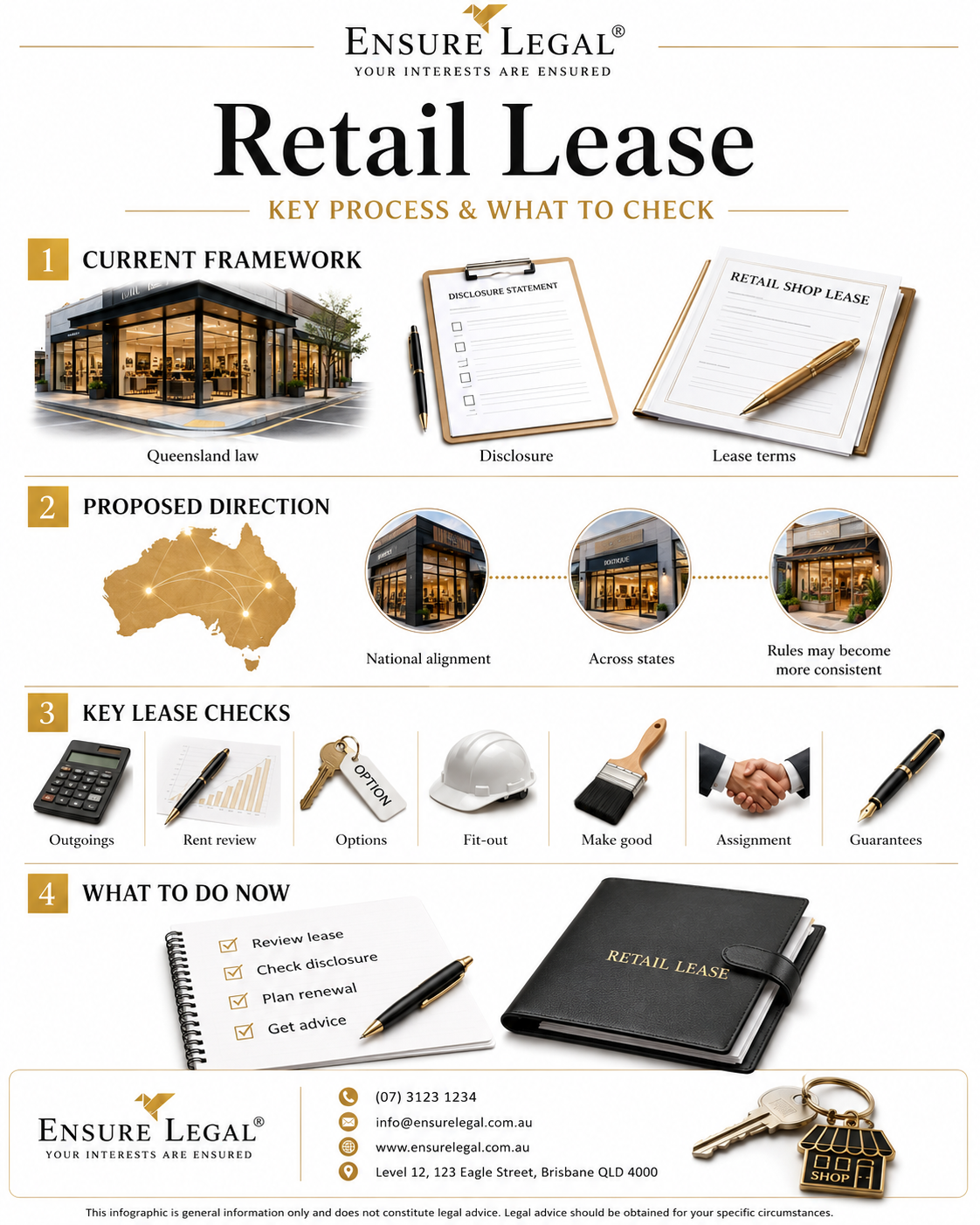
Retail leasing may be heading towards more national consistency
The Australian Government’s 2026–27 Budget does not rewrite Queensland retail leasing law overnight. However, it sends an important signal for landlords, retail tenants, franchisors and businesses operating across multiple states.
As part of its productivity and regulatory reform agenda, the Government has said it will progress work to harmonise retail tenancy frameworks, with the stated aim of making it easier to operate shopfronts across state and territory borders. The Budget material frames this as part of a broader “single national market” and National Competition Policy agenda.
For Queensland businesses, this does not mean the current Retail Shop Leases Act 1994 has been replaced. It means retail leasing may become a more active reform area, especially for businesses that lease premises in more than one state.
Why retail tenancy rules matter
Retail leases are not ordinary commercial contracts.
In Queensland, the Retail Shop Leases Act 1994 sets out laws that apply to retail shop leases. Business Queensland explains that landlords and tenants should understand their rights and obligations under the Act before entering into a retail shop lease.
The Act’s stated object is to promote efficiency and equity in certain retail businesses in Queensland. It does this through mandatory minimum standards for retail shop leases and a low-cost dispute resolution process for retail tenancy disputes.
That is why a retail shop lease is not just about rent and term. It can involve disclosure obligations, rent review mechanics, outgoings, assignment rights, refurbishment requirements, make good obligations, dispute resolution pathways and statutory protections.
What does “harmonisation” actually mean?
Harmonisation usually means making rules more consistent across jurisdictions. It does not necessarily mean every state will have identical legislation.
For retail leasing, harmonisation could potentially affect areas such as:
disclosure requirements before signing a lease;
standard forms or mandatory information statements;
outgoings disclosure and reconciliation;
minimum leasing standards;
assignment of lease requirements;
dispute resolution procedures;
definitions of retail premises;
rules affecting franchised and multi-site businesses.
The Budget papers do not yet provide a detailed model law or timetable for retail tenancy harmonisation. The more precise statement is that the Government will explore new reforms to harmonise state retail tenancy frameworks as part of National Competition Policy.
That distinction is important. Businesses should not assume the law has already changed. They should monitor reform and continue to comply with the current Queensland framework.
Why multi-site retailers should pay attention
This measure is particularly relevant for retailers, franchise systems and hospitality groups that operate in multiple states.
At present, a business leasing premises in Queensland, New South Wales, Victoria and other jurisdictions may face different retail leasing rules in each state. That can increase legal costs, compliance risk and negotiation complexity.
If retail tenancy frameworks become more consistent nationally, cross-border operators may eventually benefit from clearer compliance processes. However, during a reform period, there may also be uncertainty.
For a growing retail business, the key question is not only whether the rent is commercially acceptable. The business should also check whether its lease documentation, disclosure process and site acquisition strategy can withstand legal scrutiny across jurisdictions.
Why Queensland landlords should not wait
Landlords and shopping centre owners should also pay attention.
Retail leasing regulation often affects the landlord’s disclosure obligations, lease negotiation process and ability to recover certain costs. If national consistency becomes a policy priority, landlords may face pressure to adopt clearer documentation, more transparent outgoings disclosure and more standardised lease processes.
A poorly drafted lease may create disputes over rent review, fit-out works, relocation clauses, demolition clauses, refurbishment obligations or make good at the end of the term.
Even if future harmonisation simplifies some rules, it will not remove the need for precise lease drafting.
Key lease issues to review now
Queensland landlords and tenants should review the following before entering into, renewing or assigning a retail shop lease:
Disclosure obligations
Check whether the required disclosure documents have been prepared and exchanged correctly.
Outgoings
Confirm what costs the tenant must pay, how they are estimated, how they are reconciled and whether they are recoverable under the lease.
Rent review
Review whether rent increases are based on CPI, fixed percentage, market review or another formula.
Options to renew
Do not assume an option is automatic. The timing, notice method and conditions for exercise matter.
Fit-out and approvals
Clarify who owns the fit-out, who pays for works, what approvals are needed and whether landlord consent is required.
Make good obligations
Tenants should understand whether they must remove fit-out, reinstate the premises, repaint, repair or return the premises to a particular condition.
Assignment of lease
If the tenant sells the business, the lease assignment process can become a major transaction risk.
Personal guarantees
Directors and business owners should understand whether they are personally liable if the tenant company defaults.
Why this matters before signing
The Budget announcement should not cause panic. It should prompt a more disciplined approach to retail leasing.
If a business is entering a new lease now, it should not wait for future harmonisation before seeking advice. The current Queensland law still applies, and the lease signed today may bind the business for years.
For landlords, the issue is enforceability and risk control.
For tenants, the issue is whether the lease supports the business model or quietly creates long-term exposure.
For franchisors and multi-site operators, the issue is whether lease processes can be standardised without ignoring state-specific rules.
Speak to Ensure Legal before signing a retail shop lease
Ensure Legal assists landlords, tenants and business owners with commercial leasing and retail shop lease matters in Queensland.
Before signing, renewing, assigning or disputing a retail shop lease, it is important to obtain advice on the lease terms, statutory obligations, disclosure documents and commercial risks.
The 2026–27 Budget indicates that retail tenancy frameworks may move towards greater national consistency. However, until reforms are legislated and implemented, Queensland landlords and tenants must continue to comply with the current legal framework.
This article is general information only and does not constitute legal advice. Retail leasing obligations depend on the lease, the premises, the parties, the applicable legislation and the circumstances of the transaction.
Suggested FAQ section
Is Queensland retail leasing law changing immediately?
No. The 2026–27 Budget indicates that the Government will explore reforms to harmonise retail tenancy frameworks, but Queensland’s current retail leasing law still applies unless and until legislative changes are made.
What law applies to retail shop leases in Queensland?
Retail shop leases in Queensland are regulated by the Retail Shop Leases Act 1994, depending on the premises, business type and statutory criteria.
Why does harmonisation matter for retailers?
Retailers operating across multiple states may currently face different leasing rules in each jurisdiction. Harmonisation may eventually reduce complexity, but businesses still need state-specific advice under current law.
Should tenants still get legal advice before signing a retail lease?
Yes. A retail shop lease can create long-term obligations involving rent, outgoings, fit-out, make good, options, assignment and personal guarantees.
Can Ensure Legal review a retail shop lease in Queensland?
Yes. Ensure Legal can assist with retail shop lease review, commercial lease drafting, lease assignment and lease dispute matters in Queensland.