
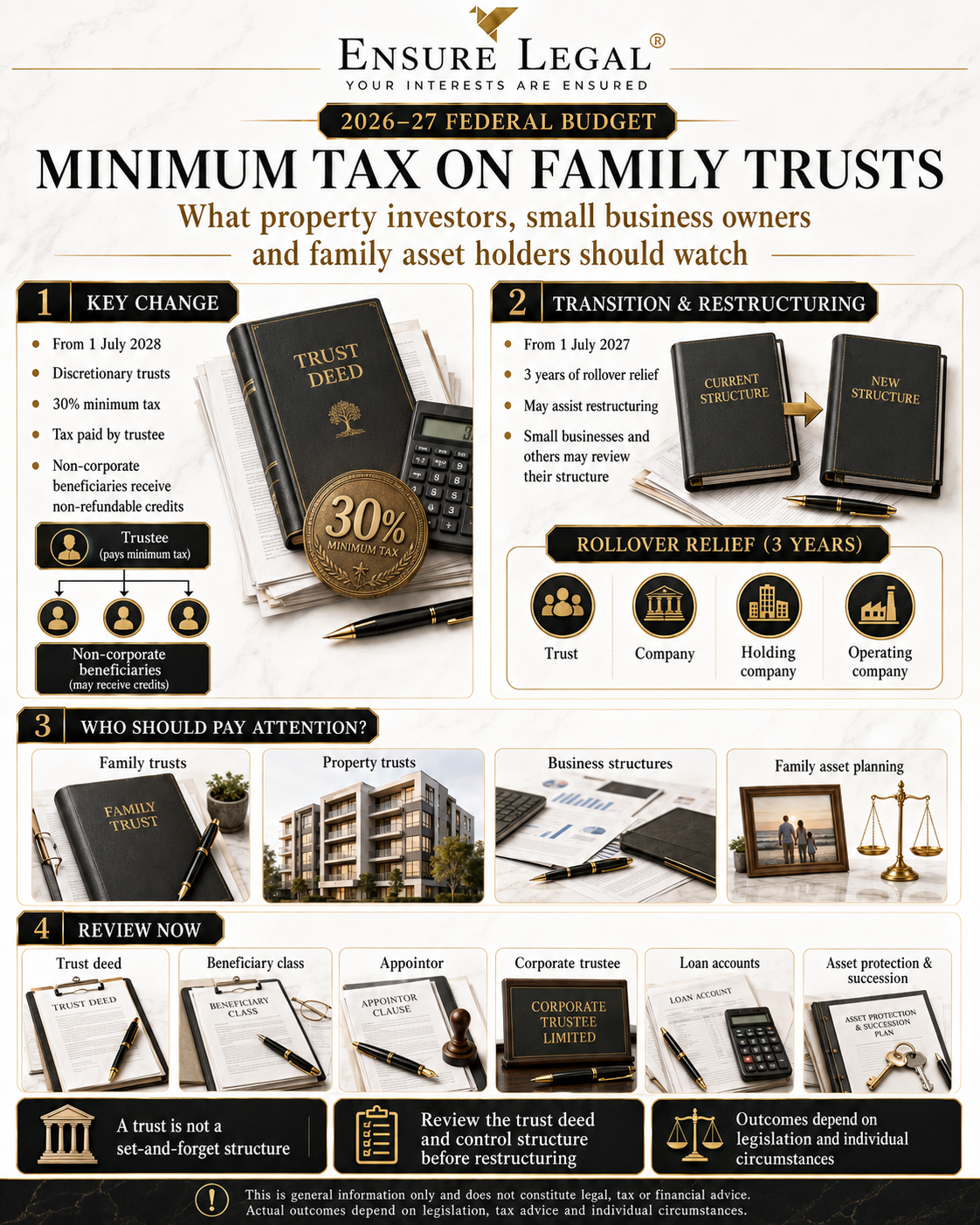
The 2026–27 Federal Budget has placed discretionary trusts, commonly referred to as family trusts, under renewed scrutiny. For property investors, business owners and high-net-worth families, this is not simply a tax headline. It is a trigger to review trust deeds, control mechanisms, asset ownership and long-term succession planning.
Key point: The Government has announced a 30% minimum tax on discretionary trusts from 1 July 2028, with three years of rollover relief from 1 July 2027 for small businesses and others that wish to restructure. The final position will depend on legislation, consultation and individual circumstances. Article contents
- What is changing?
- Why family trusts matter
- Who may be affected?
- Six things to review now
- Why property investors should pay attention
- Why business owners should review their structure
- Do not restructure without advice
- Frequently asked questions
What is changing?
The Government has announced that it will introduce a minimum tax of 30% on discretionary trusts from 1 July 2028, with some exceptions.
The trustee is expected to pay the tax because the trustee controls trust distributions. Beneficiaries will still need to declare trust income in their tax returns. Beneficiaries other than corporate beneficiaries are expected to receive non-refundable credits for tax payable by the trustee.
The policy objective is to reduce the gap between tax outcomes for people using discretionary trusts and those earning income directly, such as salary and wage earners.
Why family trusts matter
Many Australian families, property investors and business owners use discretionary trusts to hold assets, distribute income, manage risk and plan succession. These structures can still be useful, but they should not be treated as “set and forget” arrangements.
A trust created many years ago may no longer suit the current family structure, asset base, business operations or estate planning objectives. Budget reform is therefore a useful time to check whether the legal structure still supports the commercial plan.
Who may be affected?
The proposal is directed at discretionary trusts. It is not aimed at every type of trust.
The first question is therefore simple but important: what type of trust do you actually have? Many families refer generally to a “family trust”, but the legal effect depends on the trust deed, trustee, appointor, beneficiary classes and distribution powers.
Property investors
Trusts may hold residential property, commercial property, development sites, land or investment portfolios.
Business owners
Trusts may operate businesses, own business assets, receive trading income or hold shares in related entities.
Family groups
Trusts may be used for asset protection, succession planning, family distributions and long-term wealth control.
Six things to review now
Before making any restructuring decision, property investors and business owners should review the legal documents and control points behind the trust.
1. Trust deed
The trust deed controls how the trust operates. It should be checked for distribution powers, beneficiary classes, amendment powers and trustee obligations.
2. Appointor control
The appointor may have significant practical control over the trust. Succession of the appointor role should be reviewed carefully.
3. Trustee structure
A corporate trustee may offer different practical advantages from individual trustees, but company control and ASIC compliance must be managed properly.
4. Beneficiary classes
Beneficiary definitions should be reviewed to ensure they match the current family, business and estate planning position.
5. Loan accounts
Trust loans, unpaid present entitlements and related-party balances can become major issues during restructuring, sale or succession.
6. Estate planning
Trust assets are not always controlled in the same way as personally owned assets. Wills, powers of attorney and control documents should be reviewed together.
Why property investors should pay attention
Many property portfolios are held through discretionary trusts for asset protection, estate planning or family distribution reasons. If the proposed minimum tax applies, investors should review whether the current structure remains suitable.
This is especially important where the trust holds residential investment property, commercial property, development sites, company shares, business assets or loan accounts.
The question is not only whether the trust will pay more tax. The broader issue is whether the structure still works for ownership, finance, land tax, future sale, asset protection and succession.
Why business owners should review their structure
Small business owners often use discretionary trusts to operate trading businesses, hold business assets or receive income from related entities.
The Government has also announced three years of rollover relief from 1 July 2027 to support small businesses and others that wish to restructure out of discretionary trusts into other entity types.
Important: Rollover relief should not be treated as a simple invitation to move assets. Restructuring may involve tax, duty, finance, contracts, leases, licences, guarantees, shareholder arrangements and estate planning consequences.
A company, fixed trust or other structure may be suitable in some cases, but it can create different outcomes for control, retained earnings, asset protection, succession planning and future sale.
Do not restructure without legal and tax advice
Before restructuring a trust, business owners and investors should check:
- whether the trust is within the proposed rules;
- whether any exemption may apply;
- whether the trust holds land, business assets or company shares;
- whether state duty, land tax or CGT issues may arise;
- whether lenders, landlords or commercial counterparties must consent;
- whether personal guarantees, securities or leases need to be updated;
- whether the family’s estate plan still works under the proposed structure.
For businesses with leases, licences, employees or trading contracts, restructuring may require assignment or novation documents. For property investors, restructuring may affect land tax, duty, finance and future sale planning.
What should you do before 2028?
The proposed minimum tax starts from 1 July 2028, but the rollover relief window is proposed to begin from 1 July 2027. That gives families and businesses time to review their structure properly.
A measured approach is better than a rushed restructure. First, identify the trust structure and assets. Second, obtain accounting and tax advice. Third, obtain legal advice on the trust deed, control provisions, asset ownership, contracts and restructuring documents. Finally, review whether the estate planning documents still align with the structure.
Speak to Ensure Legal before restructuring a trust or business structure
Ensure Legal assists clients with property transactions, business structures, commercial agreements and legal due diligence in Queensland.
If your family trust holds property, business assets or shares, the 2026–27 Budget is a useful trigger to review whether the structure still works. Trusts can remain useful, but they should not be left unmanaged for years without legal review.
Before restructuring, transferring property, changing trustees or signing new documents, obtain legal advice and tax advice tailored to your circumstances.
Contact Ensure Legal to discuss your property, trust or business structure.
Frequently asked questions
What is a discretionary trust?
A discretionary trust is a trust where the trustee generally has discretion to decide how income or capital is distributed among eligible beneficiaries, subject to the trust deed and applicable law. Is the Government abolishing family trusts?
No. The 2026–27 Federal Budget proposes a 30% minimum tax on discretionary trusts from 1 July 2028, with some exceptions. It does not abolish discretionary trusts. When does the proposed minimum tax start?
The proposed start date is 1 July 2028. Rollover relief for eligible restructuring is proposed to be available for three years from 1 July 2027. Who pays the proposed minimum tax?
Budget material indicates that the trustee will pay the minimum tax. Beneficiaries will still declare trust income, and non-corporate beneficiaries are expected to receive non-refundable credits for tax payable by the trustee. Should I move my family trust into a company?
Not automatically. A company may suit some structures, but it can create different tax, control, asset protection, succession and commercial consequences. Legal and tax advice should be obtained before restructuring. Can Ensure Legal review trust-related property and business documents?
Yes. Ensure Legal can assist with legal review of property transactions, business structures, commercial agreements, trustee changes and restructuring documents in Queensland.
This article is general information only and does not constitute legal, tax or financial advice. The proposed measures remain subject to legislation, consultation and individual circumstances. You should obtain advice tailored to your specific circumstances before making any decision.