
Last reviewed: 14 July 2026
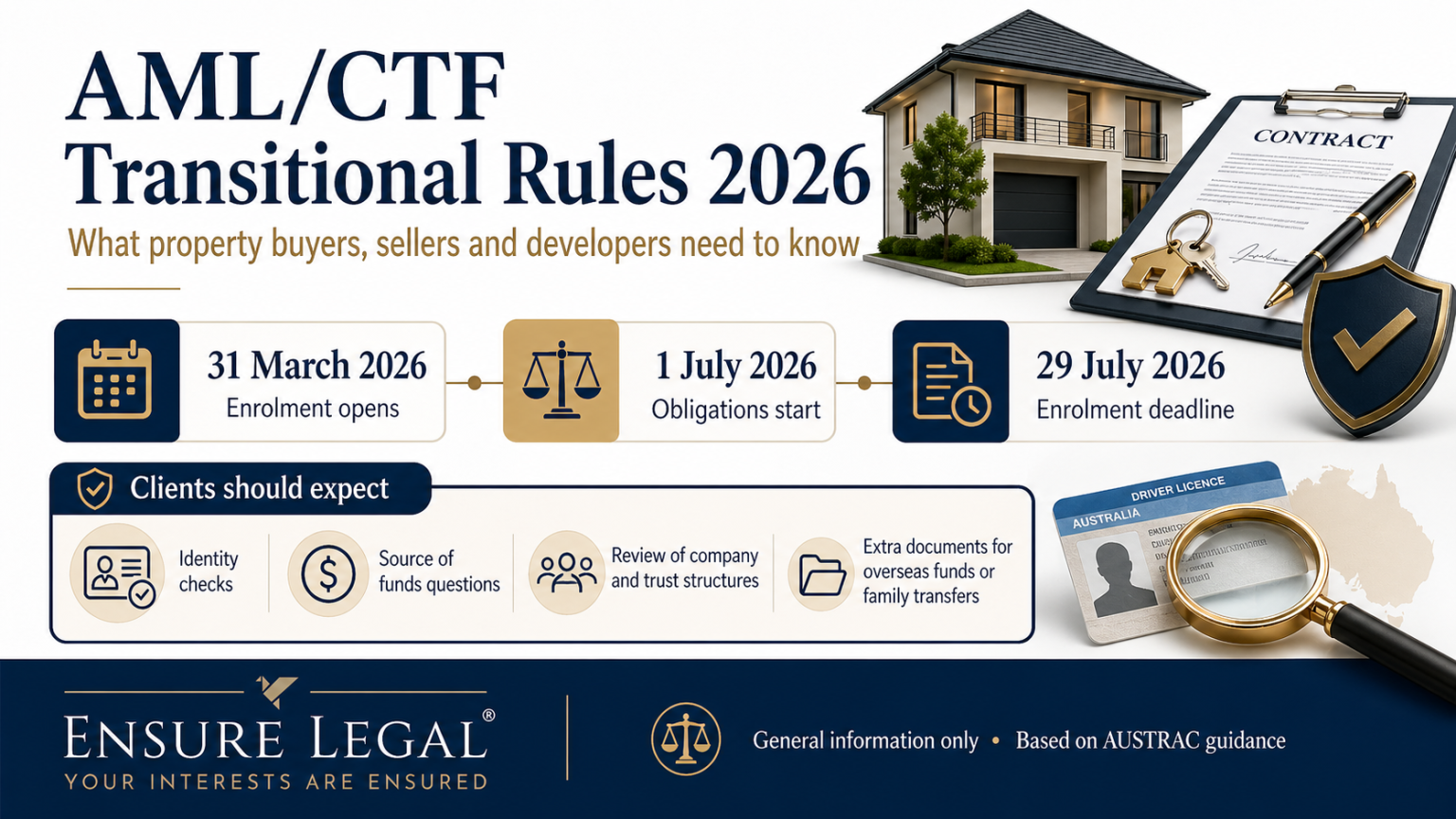
Australia’s expanded anti-money laundering and counter-terrorism financing regime now applies to certain services provided in the property and professional-services sectors.
For property buyers, sellers and developers, the practical issue is no longer simply how to prepare for commencement. The question is how the new requirements apply to current clients, existing matters, transactions that began before 1 July 2026 and services that continue after that date.
Transitional arrangements may affect when a regulated business must verify a client, identify beneficial owners, complete risk-based checks, update existing customer information and apply its AML/CTF program.
Transitional treatment should not be confused with a permanent exemption. A matter that receives temporary or phased treatment may still become subject to full requirements when the relevant condition or period ends.
Contents
- What changed on 1 July 2026?
- What are transitional rules?
- Existing clients and current matters
- Matters that began before 1 July 2026
- New services provided after commencement
- What buyers and sellers may experience
- Property developers and complex entities
- Documents clients should prepare
- Transaction timing and delay risks
- Frequently asked questions
What changed on 1 July 2026?
From 1 July 2026, the AML/CTF regime expanded to cover certain designated services provided by newly regulated businesses and professionals, including parts of the real estate, legal, conveyancing and accounting sectors.
Depending on the service being provided, a regulated business may need to:
- identify and verify its customer;
- identify individuals who ultimately own or control an entity;
- understand the purpose and intended nature of the business relationship;
- assess money-laundering and terrorism-financing risk;
- conduct enhanced checks in higher-risk circumstances;
- maintain an AML/CTF program;
- keep required records; and
- make reports to AUSTRAC where the legal reporting threshold is met.
The obligations do not apply in exactly the same way to every legal or property service. The regulated business must first determine whether the particular work involves a designated service.
What are AML/CTF transitional rules?
Transitional rules are provisions that manage the movement from the former regulatory framework to the expanded regime.
They may address issues such as:
- how existing customers are treated;
- whether earlier identity information can continue to be relied upon;
- when an existing customer must be re-verified;
- how matters already underway are handled;
- when new AML/CTF program requirements begin to apply;
- whether particular obligations are phased in;
- how pre-existing records should be retained; and
- what happens when a new designated service is provided to an existing client.
A transitional provision may delay or modify an obligation in a defined situation. It does not necessarily remove the obligation permanently.
Do existing clients need to be identified again?
Not every existing client will necessarily need to complete an entirely new identification process immediately.
However, a regulated business may need to review or update customer information where:
- a new designated service is requested;
- the earlier identification information is incomplete or outdated;
- the customer’s ownership or control has changed;
- the existing records do not meet the current verification standard;
- the customer presents a higher AML/CTF risk;
- there is doubt about the accuracy of previous information;
- the source of funds requires further explanation; or
- the business cannot adequately understand the customer or transaction.
An established relationship with a law firm, conveyancer, accountant or real estate business should therefore not be treated as a permanent exemption from future verification.
What about a property matter that began before 1 July 2026?
A matter that began before commencement may continue after 1 July 2026. The correct treatment may depend on:
- when the client relationship began;
- when the relevant designated service is provided;
- whether the service changed after commencement;
- whether additional work was requested;
- whether a new entity or purchaser was introduced;
- whether the funding arrangement changed;
- whether the customer risk profile changed; and
- the applicable transitional provisions.
The contract date alone may not determine the answer. A property matter can involve several separate services before and after signing, including contract review, due diligence, settlement, trust-money handling, incorporation, trust establishment and post-settlement work.
Clients should expect the regulated professional to assess the actual service being provided rather than assume that every pre-1 July matter is automatically outside the regime.
Existing client, but a new service after commencement
A person may be an existing client but request a new service after commencement.
Examples include:
- an existing client purchasing another property;
- a landlord instructing the firm on a new commercial lease;
- a developer creating a new special-purpose company;
- a client establishing a new trust for an acquisition;
- a seller asking the firm to receive or control transaction funds;
- a buyer changing from personal ownership to a company or trust;
- a client adding a foreign investor or joint venture partner; or
- a client requesting assistance with a new development transaction.
The new service may require the professional to update the customer profile and complete additional verification even though the firm has acted for the client previously.
What property buyers and sellers may experience
Buyers and sellers may now be asked for more information at the beginning of a matter.
Common requests may include:
- current photographic identification;
- proof of residential address;
- visa or residency information where relevant;
- details of the proposed purchaser or seller;
- company and trust documents;
- details of directors, trustees, shareholders and beneficial owners;
- bank statements showing the source of the deposit or purchase price;
- loan approval documents;
- gift letters or private loan agreements;
- sale or settlement records for another asset;
- international transfer records; and
- certified English translations.
These requests do not mean that the client is suspected of wrongdoing. They may form part of a standard risk-based onboarding process.
For a broader client guide, see: AML/CTF property rules for Queensland buyers and sellers .
Source of funds and source of wealth
Source of funds concerns the immediate origin of the money being used in the transaction.
Examples include:
- personal savings;
- bank finance;
- sale proceeds;
- business income;
- investment redemptions;
- inheritance;
- a family gift;
- a private loan; or
- funds transferred from an overseas account.
Source of wealth is broader. It concerns how a person accumulated their overall financial position.
A regulated business may require further evidence where the transaction, ownership structure or funding arrangement presents a higher risk.
Where family money is involved, see: family gifts, gift letters and source-of-funds evidence .
Beneficial ownership and entity verification
Where a company, trust, partnership or other entity is involved, the regulated professional may need to identify the individuals who ultimately own or control it.
The legal name of the purchasing company or trustee may not be sufficient by itself.
Relevant documents may include:
- company extracts;
- shareholder registers;
- constitutions;
- trust deeds and variations;
- unit-holder registers;
- group structure charts;
- joint venture agreements;
- director and trustee resolutions;
- documents identifying beneficial owners; and
- evidence of authority to act.
Why property developers may face more complex checks
Property development transactions commonly involve more complex ownership, funding and contractual structures than a straightforward residential purchase.
A developer may operate through:
- a special-purpose company;
- a unit trust;
- a discretionary trust;
- a joint venture;
- an overseas parent company;
- related-party finance;
- private equity or syndicated investment;
- several layers of holding entities; or
- a nominee or bare-trust arrangement.
The professional adviser may therefore need to understand:
- the complete group structure;
- the ultimate beneficial owners;
- the source of equity and debt funding;
- the relationship between related entities;
- the role of foreign investors;
- the intended acquisition and development structure;
- who controls transaction accounts; and
- whether any politically exposed person or higher-risk jurisdiction is involved.
Developers should prepare these materials before acquisition or finance deadlines become urgent.
Ensure Legal advises on Queensland property development transactions and commercial property acquisitions .
Changes to the purchaser or structure during a transaction
A change to the purchasing structure may trigger additional onboarding and verification requirements.
Examples include:
- substituting a company for an individual buyer;
- changing the trustee;
- adding a joint venture partner;
- changing ownership percentages;
- introducing an overseas investor;
- changing the source of settlement funds;
- using a third-party payer; or
- assigning or nominating another purchaser.
These changes may also create separate duty, FIRB, finance and contractual consequences.
Practical document checklist
Buyers, sellers and developers should consider preparing the following documents where relevant:
- current passports and driver licences;
- proof of residential address;
- visa or residency evidence;
- company extracts and constitutions;
- shareholder and beneficial ownership records;
- trust deeds and variations;
- unit-holder registers;
- organisation charts;
- joint venture agreements;
- director and trustee resolutions;
- bank statements;
- loan and finance documents;
- gift letters or private loan agreements;
- sale and settlement records;
- inheritance documents;
- international transfer records;
- documents explaining third-party payments; and
- certified translations.
The regulated business may request different or additional information depending on the matter.
Can AML/CTF checks delay settlement?
They can contribute to delay where information is supplied late, incomplete or inconsistently.
Common causes include:
- expired identification;
- missing trust documents;
- unclear beneficial ownership;
- funds arriving from an unexpected account;
- third-party payments;
- unexplained overseas transfers;
- last-minute changes to the buyer;
- inconsistent information provided to different advisers;
- uncertified foreign-language documents; and
- failure to respond to follow-up enquiries.
AML/CTF checks do not automatically extend contractual dates for deposits, finance, due diligence or settlement.
Clients should therefore provide requested documents as early as possible.
What if the requested information is not provided?
A regulated professional may be unable to commence or continue providing a designated service where the required identification, verification or risk information has not been obtained.
The professional may also be legally restricted from disclosing whether a suspicious matter report has been or may be submitted.
Clients should not interpret every request for information as an allegation. The request may simply be required by the firm’s AML/CTF program.
Transitional treatment is not an exemption
A transitional arrangement may:
- allow limited reliance on earlier customer information;
- phase the application of a requirement;
- provide additional time for a defined compliance step; or
- preserve the treatment of a matter in specified circumstances.
It should not be assumed to:
- exempt the client indefinitely;
- remove the need to update outdated information;
- apply to every service provided after commencement;
- override higher-risk customer due diligence; or
- permit a regulated business to ignore suspicious or inconsistent information.
What clients should do now
- Engage the professional early. Do not wait until immediately before signing or settlement.
- Identify the correct client and purchaser. Confirm whether the matter involves an individual, company, trust or joint venture.
- Provide ownership documents. Explain who ultimately owns and controls each relevant entity.
- Explain the funding arrangement. Identify the deposit source, lender, equity contributors and settlement account.
- Disclose overseas or third-party funds. Do not wait for the professional to discover them shortly before settlement.
- Keep information consistent. Details provided to the bank, accountant, agent and lawyer should align.
- Allow time for follow-up questions. Complex structures may require additional review.
- Do not assume an old client file is sufficient. Updated verification may be required for a new transaction or service.
Frequently asked questions
Did the new AML/CTF rules begin on 1 July 2026?
Yes. The expanded regime commenced for relevant newly regulated services from 1 July 2026.
Does every existing client need to be verified again immediately?
Not necessarily. The answer depends on the transitional rules, the quality of existing information, the service being provided and the customer’s risk profile.
Is a matter exempt because the contract was signed before 1 July 2026?
Not automatically. The relevant issue may be when the designated service is provided and whether the service or client relationship changes after commencement.
Can a firm rely on identification collected several years ago?
It may need to assess whether the information remains reliable, current and sufficient under its AML/CTF program.
Does an existing client avoid checks when buying another property?
No automatic exemption applies merely because the firm has acted before. A new transaction or designated service may require updated checks.
Can settlement proceed while documents are outstanding?
That depends on the applicable obligations and the firm’s ability to provide the service lawfully. Contractual deadlines may continue to run.
Do the transitional rules replace FIRB or AFAD requirements?
No. AML/CTF, foreign investment approval and Queensland duty are separate legal regimes.
How Ensure Legal can assist
Ensure Legal advises buyers, sellers, investors and property developers on Queensland property transactions and related compliance issues.
Our services may include:
- property contract review;
- Queensland conveyancing;
- commercial property transactions;
- property development acquisitions;
- company and trust structure review;
- foreign buyer and FIRB advice;
- source-of-funds documentation review; and
- transaction planning involving complex ownership or funding arrangements.
Read our general guide to AML/CTF property transaction requirements or our guide for overseas property buyers .
Contact Ensure Legal about a Queensland property transaction
Disclaimer: This article provides general information only and does not constitute legal advice. AML/CTF obligations and transitional arrangements depend on the particular business, client, designated service, timing and risk circumstances. Obtain advice about your specific situation.